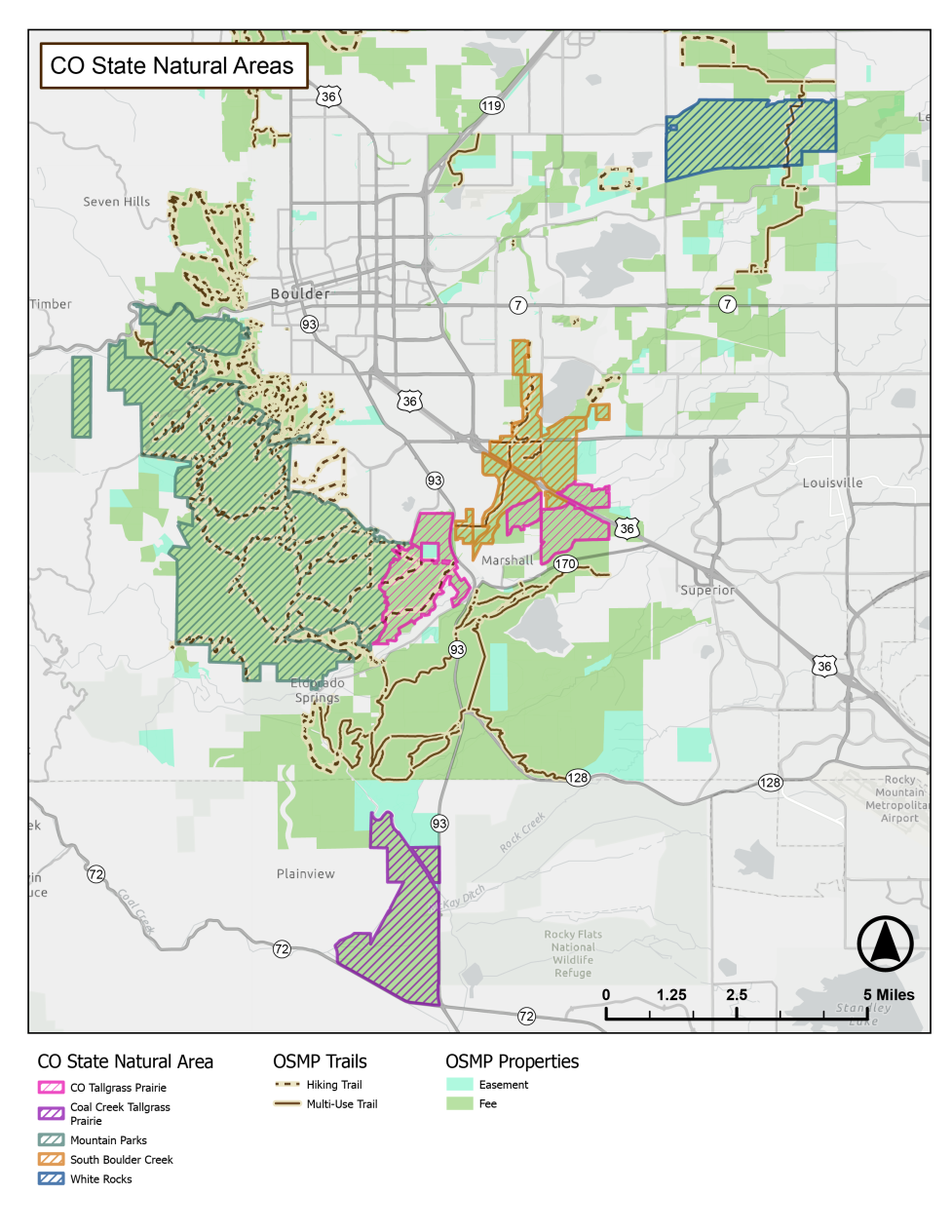
White Rocks Natural Area
Martha (Ricky) Weiser and CNAP designated 111 acres in 1979, originally highlighting the 64-million-year-old Fox Hill cliffs, riparian corridor, and floodplain meadows. The area includes several rare plants and animals, bald eagle nesting habitat, and notable geologic features. The City of Boulder purchased the Weiser property in 2011 and the adjacent Ertl properties in 2015. The Natural Area was expanded in 2023 to encompass the full extent of the cliffs, as well as additional riparian and floodplain meadow habitat. Due to the area’s sensitive habitat, public access is not allowed except through staff-guided educational field trips.
Colorado Tallgrass Prairie Natural Area
The Colorado Tallgrass Prairie State Natural Area encompasses approximately 1,347 acres of OSMP-managed land. The Colorado Tallgrass Prairie is a remnant of a once-extensive tallgrass prairie that occupied the South Boulder Creek floodplain and portions of the ancient glacial outwash surfaces along the Front Range. OSMP led the City’s designation process for the Natural Area in 1984, when the original parcels were selected from a CNAP inventory as some of the largest and highest-quality tallgrass prairie remnants in Colorado. The designation was expanded in 2023 to include additional high-quality tallgrass areas. The Natural Area contains high-quality examples of rare and imperiled mesic and xeric tallgrass prairie communities, numerous rare plant species, and habitat for wildlife with significant conservation needs. Species found within these communities include bobolink, grasshopper sparrow, golden eagle, burrowing owl, northern leopard frog, Preble’s meadow jumping mouse, Ottoe skipper, regal fritillary, and Ute ladies’-tresses, as well as rare plants such as prairie violet, slimleaf milkweed, and dwarf leadplant.
Public access varies, with South Boulder Creek West and Big Bluestem trails providing close-up views of the Natural Area, along with seasonal wildlife protection closures.
South Boulder Creek Natural Area
A mosaic of high-quality wetlands, wet meadows, willow shrublands, plains riparian forests, and tallgrass prairie was designated in 2000 and covers approximately 1,240 acres. The area provides habitat for several species of state and national concern, including the federally listed Ute ladies’-tresses orchid and Preble’s meadow jumping mouse, as well as northern leopard frog, Bobolink, native fish species, and rare wetland plant communities. It is also a working landscape, where well-timed cattle grazing, irrigation, and haying help maintain viable habitats within the Natural Area. Public access is available via the South Boulder Creek Trail.
Boulder Mountain Park Natural Area
Boulder’s largest natural area, at over 7,000 acres, includes three major canyon systems, the iconic Flatirons, and three peaks over 8,000 feet and was designated in 2009. The area contains some of the highest concentrations of biological diversity in the state and region, including relic Eastern woodland forest communities, cliff communities, numerous rare and sensitive plant and wildlife species, and plant species more commonly found at higher elevations and latitudes. Its steep topography, situated between the foothills and plains, supports a wide variety of habitat types within a relatively small area. Public access is available through the OSMP trail system within the Natural Area, subject to Habitat Conservation Area regulations and seasonal wildlife protection closures.
Coal Creek Tallgrass Prairie
The OSMP Jewel Mountain and Van Vleet JeffCo properties were purchased in 1999 and encompass 1,458 acres. It was designated as a Natural Area in 2023. The area contains a particularly rare xeric tallgrass type, where montane and prairie plant species blend within a unique geologic setting. Located on the western part of Rocky Flats Mesa, the area is buffered by adjacent public land and provides habitat for rare butterflies, ground-nesting birds with dwindling Great Plains populations, state-tracked species such as the northern leopard frog, and several rare plant species. The area is also a significant site for First Nation people. Due to its sensitive habitat, public access is not allowed except through staff-guided educational field trips.