In late 2024, the City of Boulder Office of Arts and Culture began surveying both venue* managers and venue users to better understand the local arts and culture space landscape. This report draws on the responses collected by Office of Arts and Culture staff and will inform the Boulder Arts Blueprint as well as broader discussions around cultural facilities. While additional outreach may occur in the future, this document represents the final report summarizing findings from this phase of the study.
Office of Arts and Culture staff collected 28 survey responses from venue managers, covering 26 distinct spaces operated by 20 organizations. These spaces are used for events, meetings, performances, readings, screenings, exhibitions, classes, and studio work. Many venues support multiple art forms and cross-disciplinary uses. Staff also collected 25 responses from venue users (artists and leaders of arts organizations). These respondents primarily identified with the performing arts, with additional representation from visual arts, time-based media, public art/festival work, and educational programming.
Together, these responses illustrate both the strengths and the constraints of Boulder’s arts ecosystem. Across both groups, affordability, availability, and suitability of space emerge as persistent challenges that significantly impact the ability of artists and organizations to create, rehearse, present, and sustain their work in the city.
Key Findings
From Venue Managers
Ownership (organization-level)
After combining multiple entries submitted by organizations managing more than one space, the following patterns emerge among the 20 organizations represented:
8 organizations own their building(s)
11 organizations lease their building(s)
1 organization—the Boulder Public Library District—operates multiple facilities with mixed ownership
This creates an ownership landscape that is nearly evenly split between owned and leased facilities, with the library district serving as a hybrid case.
Space Types
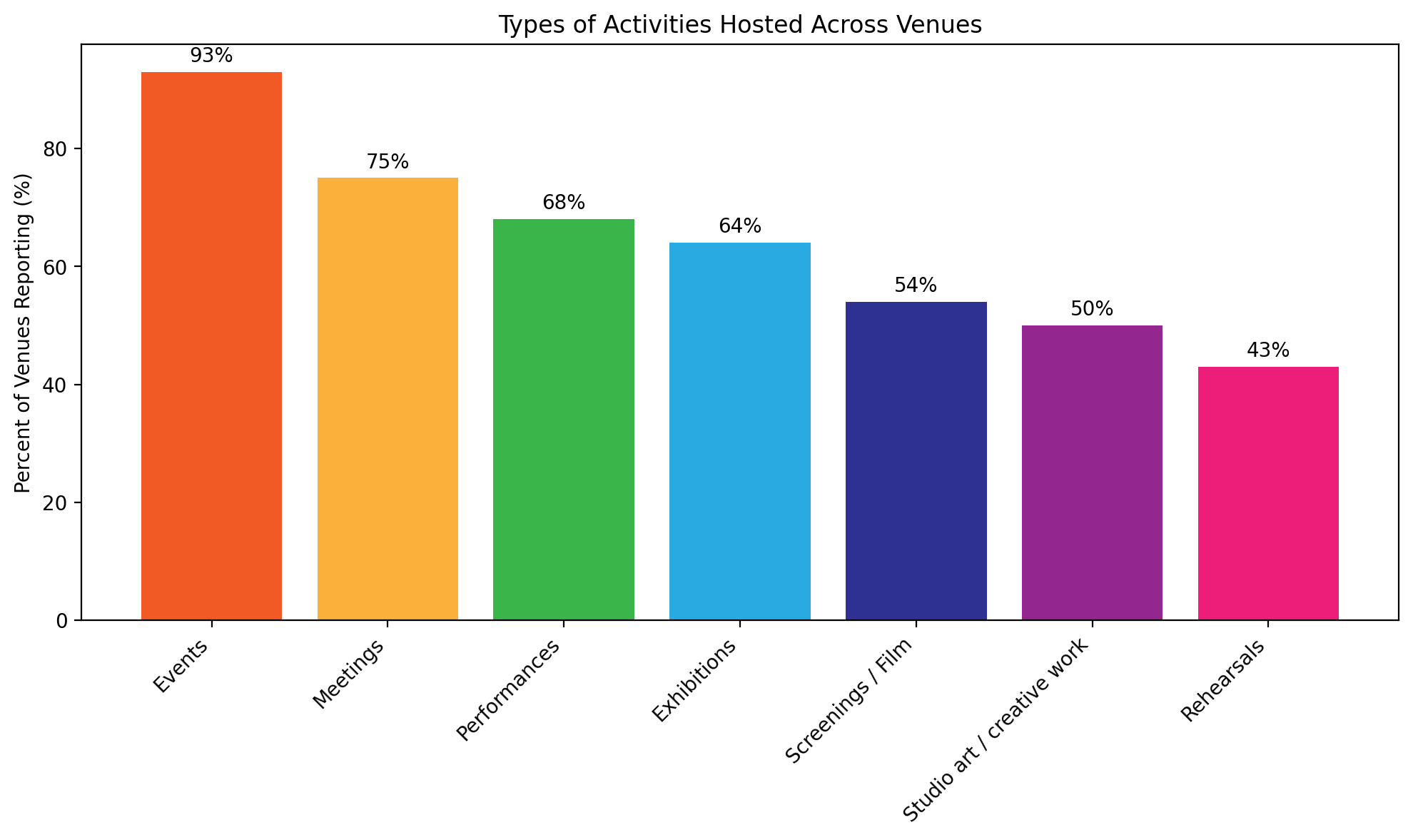
Across the 28 spaces described, venues reported hosting:
Many venue managers described their spaces as flexible and multipurpose—supporting artistic production, community gatherings, classes, workshops, and civic activities.
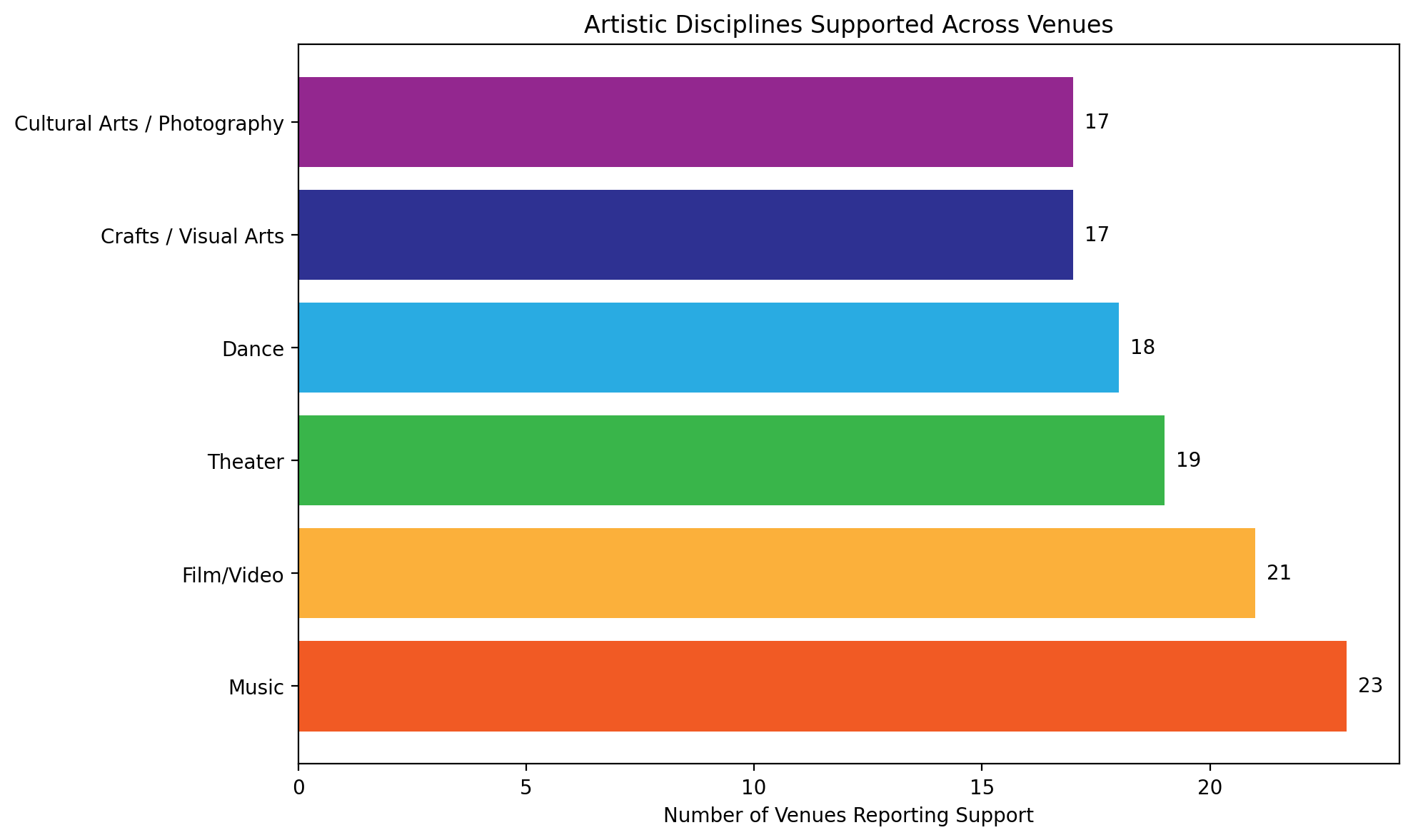
Disciplines Supported
Most spaces support multiple artistic disciplines.
Note: A smaller number of venues also support circus arts, culinary arts and makerspace activities.
Overall, the venue ecosystem demonstrates breadth and versatility, with many spaces accommodating a blend of performing, visual, and media arts activities.
Top Challenges
When aggregated at the organization level (to avoid over-counting multi-space entities), the leading challenges cited by venue managers include:
Affordability and financial strain: Noted by 12 of the 16 organizations, driven by pressures such as rent or mortgage costs, utilities, insurance, taxes, and rising operational overhead.
Maintenance and facility needs: 4 organizations cited aging infrastructure, expensive repairs, and specialized facility requirements such as sprung floors or elevator maintenance.
Staffing and operational capacity: 5 organizations described limited staffing as a barrier to fully utilizing or renting their spaces.
Visibility and audience engagement: 4 organizations reported difficulty attracting audiences or being located away from high-traffic areas.
Displacement or lease insecurity: at least one organization reported an urgent need to find new affordable space due to lease changes.
Funding Models
Among the 16 organizations that described their funding sources:
Individual donors: 11
Rental income: 11
Earned income (tickets, classes, etc.): 11
Private foundations: 9
Government grants: 8
Fundraising events: 8
In-kind support: 8
Memberships: 7
Corporate sponsorships: 6
The data show that organizations generally sustain operations through multiple concurrent revenue streams, balancing earned income with philanthropic and public support.
From Venue Users
Who Responded
Among the 25 artists and arts organizations who responded, with many selecting multiple categories:
Performing Arts: 16
Visual Arts & Crafts: 6
Film / Video / Digital / Web-based Art: 5
Additional representation from festivals, public art, education, and heritage/history sectors
The sample is strongest in the performing arts but still represents a diverse array of practices.
Access Barriers
When asked whether space challenges in Boulder prevented them from making, teaching, or presenting their art in recent years:
17 of 25 (68%) responded Yes
8 of 25 (32%) responded No
Key themes included:
Affordability: cited by 17 of 23 respondents who elaborated
Availability and scheduling challenges: 11 respondents
Restrictive policies or requirements: mentioned frequently
These barriers diminish creative opportunity and activity in Boulder.
What Artists Do When They Can't Find Space
(Respondents could select multiple options.)
Found suitable space in another city: 10 (40%)
Used a space that wasn’t the right fit: 4 (16%)
Canceled a project: 3 (12%)
Adjusted the work to fit the available space: 3 (12%)
These responses indicate that Boulder is losing cultural production, audience engagement, and economic impact to neighboring communities.
Space Needs, Budgets, and Capacity
Narrative responses showed that:
Rehearsal space: Artists generally consider $20–$25/hour affordable.
Performance rentals:
~$700 for a weekend for two concerts
~$4,000 for a week-long rental
$4,000–$6,000/week for larger or more fully equipped venues
Studio rentals:
~$235/month for small spaces outside Boulder
Ideal Boulder range: $300–$600/month for 300–600 sq ft
Ideal seating capacity:
Most respondents identified 50–500 seats as appropriate for their work
A smaller number required under 50 seats or 500–1,000 seats
Artists emphasized the importance of balancing affordability, technical quality, and reliable availability.
Analysis and Insights
Affordability Is the Central Concern
Both users and venue managers identified affordability as the most significant barrier. For venue managers, escalating operational costs strain budgets. For artists, rental rates and supplementary fees frequently limit access.
Fee Structures and Policies Create Additional Barriers.
Artists identified several structural and administrative barriers:
Non-refundable deposits
Minimum rental blocks
Required use of in-house staff
Additional ticketing fees
Restrictions on materials, food/drink, or types of artwork
Permitting complexity
These policies often determine whether a space is feasible for an artist or organization.
Mismatch Between Available Spaces and Artistic Needs
Despite the presence of many types of venues in Boulder, artists often struggle to find spaces that meet their specific needs regarding:
Stage time
Technical rehearsal time
Acoustic quality
Sprung floors
Lighting grids
Long-term affordable studios
Use limitations instituted by city code or zoning
Artists Are Leaving Boulder or Adapting Their Work
With a significant share of respondents booking space outside the city and others using suboptimal spaces, Boulder is losing creative activity and its associated cultural and economic benefits.
Strong Desire for Shared Community Spaces
Responses show clear interest in:
Shared or collaborative studios
Flexible rehearsal/performance spaces
Community-oriented creative hubs
Spaces designed for both creation and presentation
These spaces support both affordability and community-building.
Findings By Creative Discipline
Performing Arts
User-Identified Challenges
Performing arts respondents commonly identified:
High costs for both rehearsal and performance spaces
Limited access to stage and technical rehearsals
Insufficient amenities such as lighting grids, sprung floors, and backstage spaces
Scheduling complications and calendar competition
Manager-Identified Challenges
Venue managers described:
High overhead and maintenance costs
Specialized facility needs
Dependence on mixed revenue streams
Through-Lines
Both groups experience financial strain and point to the need for affordable, flexible, and well-equipped spaces.
Fee structures and ticketing systems are recurring pain points.
Visual Arts
User-Identified Challenges
Visual arts respondents cited:
Lack of affordable, long-term gallery or studio spaces
Difficulty securing visible and accessible spaces
Reliance on home studios or improvised environments
Limitations from city zoning
Manager-Identified Challenges
Managers of visual arts spaces reported:
Challenges with visibility and audience engagement
High costs of operating multi-use, public-facing spaces
Limited budgets for maintenance and upgrades
Through-Lines
Both groups emphasized the need for stable, affordable, and visible spaces for creation and exhibition.
Multidisciplinary / Other
This category had sparse or mixed entries, often bundled with performing or visual arts.
Observed Themes:
Artists juggling multiple disciplines often struggle with finding a space that accommodates all their needs (e.g., mixed-media install, movement, digital work).
Venues that identify as flexible or raw spaces tend to serve these needs but may still be unaffordable or booked out.
Cultural Asset Mapping
As part of broader cultural planning efforts, the City of Boulder Office of Arts and Culture is has developed a Cultural Assets Map to visualize the distribution of cultural resources across the city.
The map includes venues and creative spaces, public art and murals, grant-funded arts projects, other cultural amenities, and geographic patterns of creative activity. This mapping initiative will support the Boulder Arts Blueprint by helping identify areas rich in cultural activity, neighborhoods with gaps or unmet needs, and opportunities for strategic investment, partnerships, and support.