

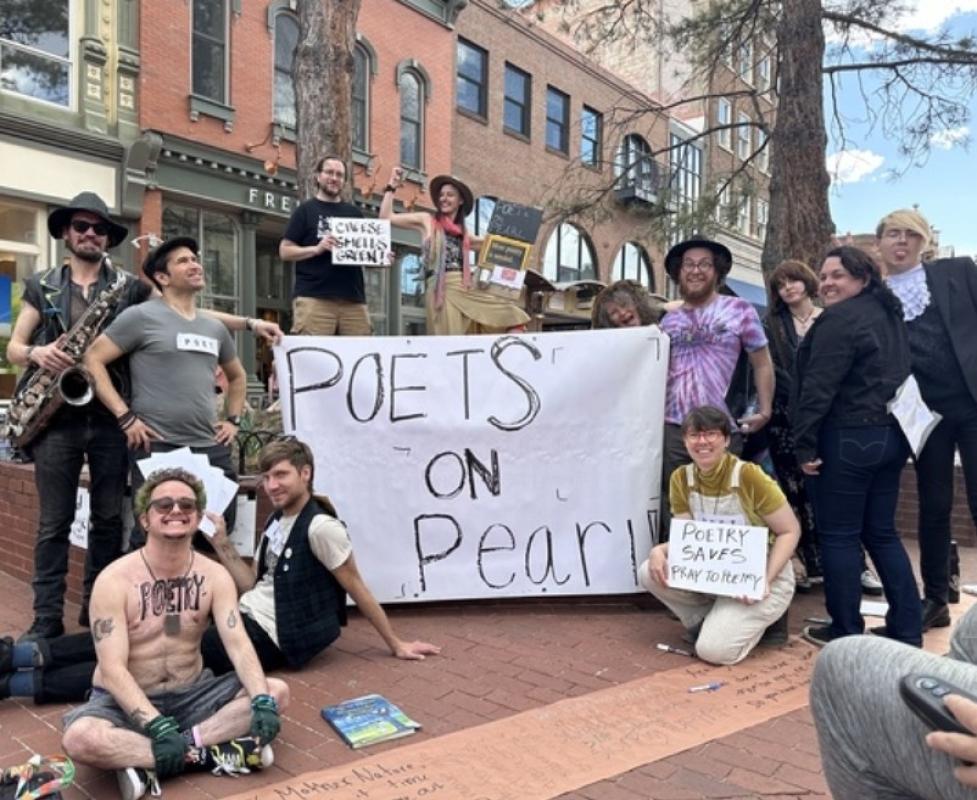
Boulder has long been more than a city that supports poetry-- it has been a place where poetry happens in public life. For decades, writers, artists, students, seekers, activists, musicians, and neighbors of all kind have gathered here to test language against the world: in classrooms and cafés, libraries and living rooms, on stages, sidewalks, and mountain trails.
The city holds a unique place in the landscape of American poetics. Since the founding of Naropa University’s Jack Kerouac School of Disembodied Poetics in 1974 by Anne Waldman and Allen Ginsberg, Boulder has served as an international home for experimental writing, contemplative practice, performance, and community-based literary culture. Generations of influential poets and artists have come through Boulder not simply to teach or perform, but to imagine new relationships between art, consciousness, civic life, and collective imagination.
Tucked against the foothills, the city became, somewhat improbably, one of the major crossroads of postwar experimental literature: a meeting ground for Beat writers, Buddhist thinkers, avant-garde artists, radical pedagogues, performance poets, ecological writers, and generations of young people searching for new forms of language and life.
The founding of Naropa University’s Jack Kerouac School of Disembodied Poetics transformed Boulder into an international center for contemporary poetics. It was the first fully accredited Buddhist-inspired university in the United States, and the Kerouac School quickly became one of the most influential spaces for experimental writing anywhere in the world. Allen Ginsberg wrote and taught here. William Burroughs lectured here. John Cage performed here. Gregory Corso wandered through here. Diane di Prima, Amiri Baraka, Alice Notley, Joanne Kyger, Bernadette Mayer, Audre Lorde, Eileen Myles, Cecilia Vicuña, Bhanu Kapil, CAConrad, and countless others have all contributed to the evolving literary ecosystem that Boulder alone has unique fostered.
The city became a kind of unofficial western capital for the afterlives of the Beat movement.. not as nostalgia, but as an ongoing experiment: poetry as public practice, spiritual inquiry, improvisation, dissent, conversation, and community-making. Here, poetry escaped the page and entered everyday life. Readings spilled out of lecture halls into kitchens, cafés, bookstores, libraries, meditation centers, and mountain cabins. The boundaries between poetry, music, philosophy, ecology, activism, and performance often dissolved.
That atmosphere still lingers in Boulder’s cultural DNA. The city continues to sustain an unusually vibrant literary ecology: independent bookstores and presses, public readings, youth workshops, library programs, spoken word communities, contemplative arts spaces, interdisciplinary collaborations, and generations of writers who continue to arrive here looking for permission to think and speak differently.
The Boulder Poet Laureate Program emerges organically from this living history. It recognizes that poetry is not peripheral to Boulder’s civic identity, but deeply woven into it. A Poet Laureate would not simply promote literary arts, they would help animate an existing tradition of public language, creative risk, listening, and shared imagination.
Valerie Hsiung (she/her)
Assistant Professor, Creative Writing & Poetics
Chair, Jack Kerouac School of Disembodied Poetics