

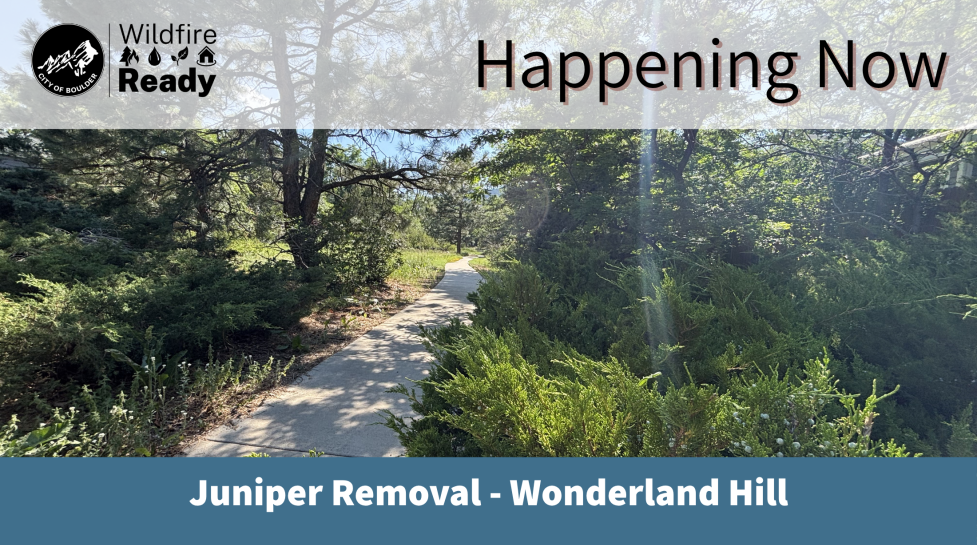
Junipers used as decoration will be removed and eventually replaced by more resilient landscaping to mitigate wildfire risk
The City of Boulder is helping community members reimagine what a wildfire resilient landscape can look like through a new pilot project near Wonderland Lake by replacing several high-risk juniper plantings with native, low-flammability vegetation on city owned property.
The Juniper Removal and Replacement Pilot Project, located along the Wonderland Lake Park access path south of Orion Court, will change five example landscape areas that represent common juniper planting styles found throughout Boulder neighborhoods. The project is designed to give community members real-world examples of how existing landscaping can be replaced with plants that are both beautiful and better suited to Boulder’s changing climate and wildfire risk.
“This project reflects a broader shift in how we think about resilience, not just responding to wildfire risk, but designing our landscapes to live with it,” said Climate Initiatives Department Director Jonathan Koehn. “By rethinking what we plant today, we can create neighborhoods that are safer, healthier and better prepared for the future.”
The pilot program will remove junipers in the following areas of Wonderland Lake Park across from Wonderland Hill Ave:
- Park Access Path Entry – currently provides screening and stand-alone accent that will need replacement
- Medium Junipers Along Path – currently used as vegetation structure for the path that will need replacement
- Small Junipers Along Path – small plant where replacement is not needed
Junipers have been widely used in residential landscapes because they are hardy and evergreen. “We see a fair number of junipers throughout the community because they are native and easy to maintain,” said Boulder Fire-Rescue Fire Marshall David Lowrey, “However, they are dense and oily plants and tend to accumulate dead material which makes them highly flammable. In high-risk areas like the city’s wildland urban interface, large juniper plantings near homes and structures can increase fire intensity and the potential for fire spread.”
The City of Boulder has mapped junipers on public lands and is prioritizing removals in areas with the greatest wildfire risk, including locations within the wildland-urban interface and near structures. While there is increased community interest in removing junipers, this work requires a phased approach. Junipers in lower-risk areas will be addressed through future projects after higher-risk locations have been prioritized. This fall, crews will plant new vegetation in the areas where some of the junipers previously were, prioritizing native deciduous trees, low-flammability shrubs, flowering plants, cacti and more. These new and improved landscapes are being designed to lessen the water needed to irrigate and support local wildlife health.
The city hopes the project will inspire property owners and neighborhoods to evaluate their own landscapes and consider replacing highly flammable vegetation with more resilient options.
The project aligns with Boulder’s broader wildfire resilience efforts and builds upon the city’s recently released Wildfire Resilient Landscapes Guide, which helps community members choose plants and landscape designs that reduce wildfire risk around homes and neighborhoods. Wildfire resilience is a shared community responsibility and there are numerous ways to get involved. You can learn more about the Wildfire Resilient Landscapes Guide and wildfire resilience work in the City of Boulder by visiting bouldercolorado.gov/WildfireReady.
Keep Reading
News keep reading
-
City of Boulder Begins Fall Wildfire Grazing at Chautauqua Meadows
-
Boulder Community Invited to Help Shape Priorities for Power Reliability and Resilience
-
Boulder Selects Nonprofits for Community Resilience Hub Pilot Program
-
City of Boulder to Begin Construction of South Boulder Creek Flood Mitigation Project