

Application open April 20 through May 15, 2026
Purpose
The city recognizes that neighbors to city-owned or managed open space land may be concerned about prairie dogs colonizing their properties and causing damage to landscaping, creating hazards for livestock, or otherwise conflicting with land use. While prairie dogs are native wildlife that move freely and by law are managed by the State of Colorado, the city has developed a cost-share program to construct barriers to discourage prairie dog movement onto private property from adjacent prairie dog colonies on Open Space Land.
The City of Boulder Open Space and Mountain Parks department (OSMP) will provide funds to share up to 50% of the cost of a barrier project, at a cost of $12.88 per foot, to a maximum of $10,000 (total) per project through a competitive grant process. This will help minimize conflict with land uses on adjoining properties while protecting prairie dog habitat objectives on open space lands.
Eligibility Requirements
To be eligible to apply for the cost-share grant funding, you must meet the following:
Properties must be private residential or agricultural properties that share a boundary with, or are directly adjacent across, a road to City of Boulder Open Space Lands that have active prairie dog colonies present.
Work must be started after notification of award from OSMP to be eligible for funding.
City of Boulder residency not required.
Applicants may apply during future application periods, regardless of whether funding was received in the current or any previous round.
Barrier Standards
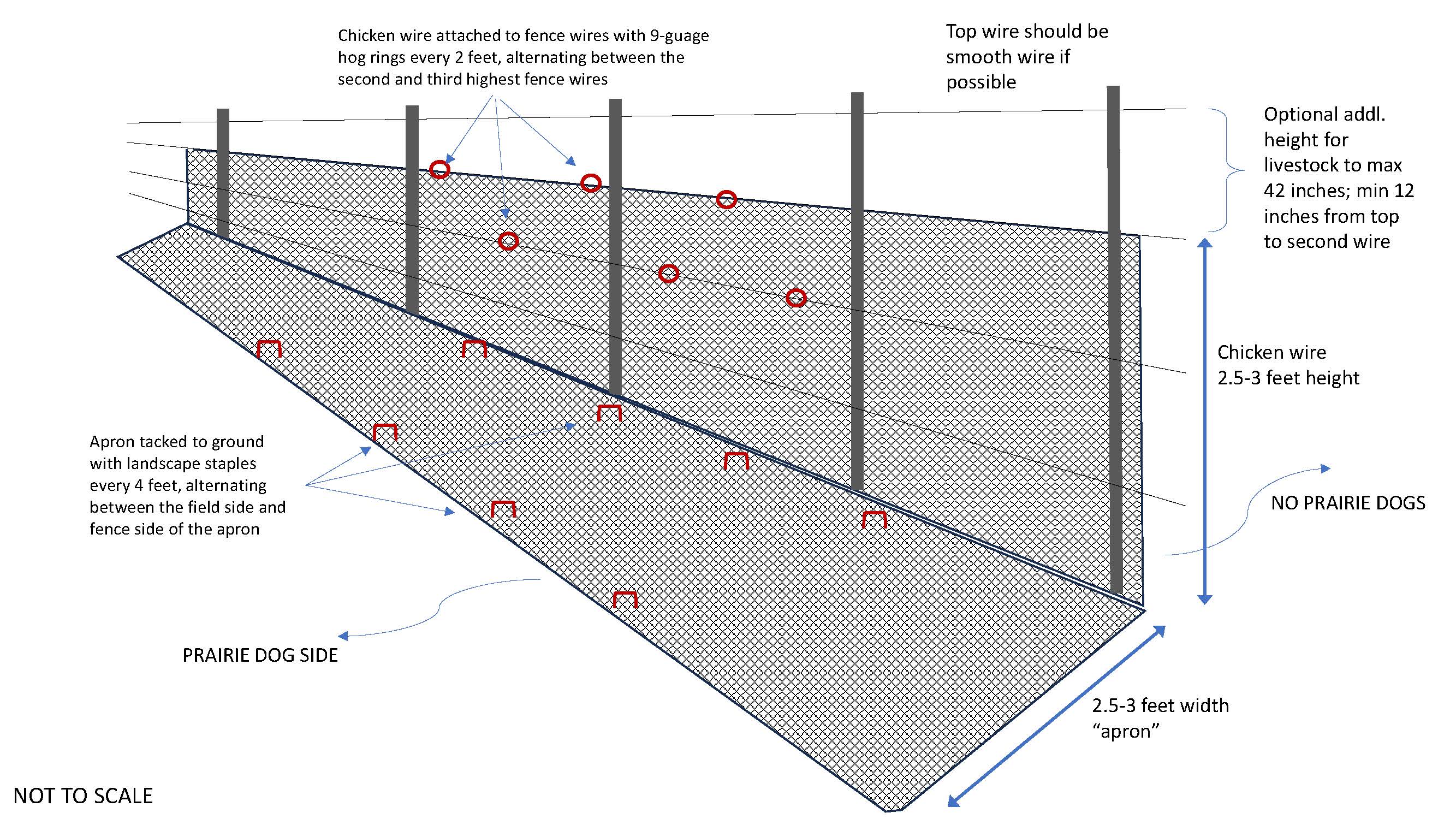
Barrier cost-share awards are based on the cost per linear foot for a chicken wire barrier that is 3 feet tall and has a 3-foot apron on the ground facing the prairie dog colony. This is the recommended barrier type and is used primarily where barriers are required throughout the OSMP system.
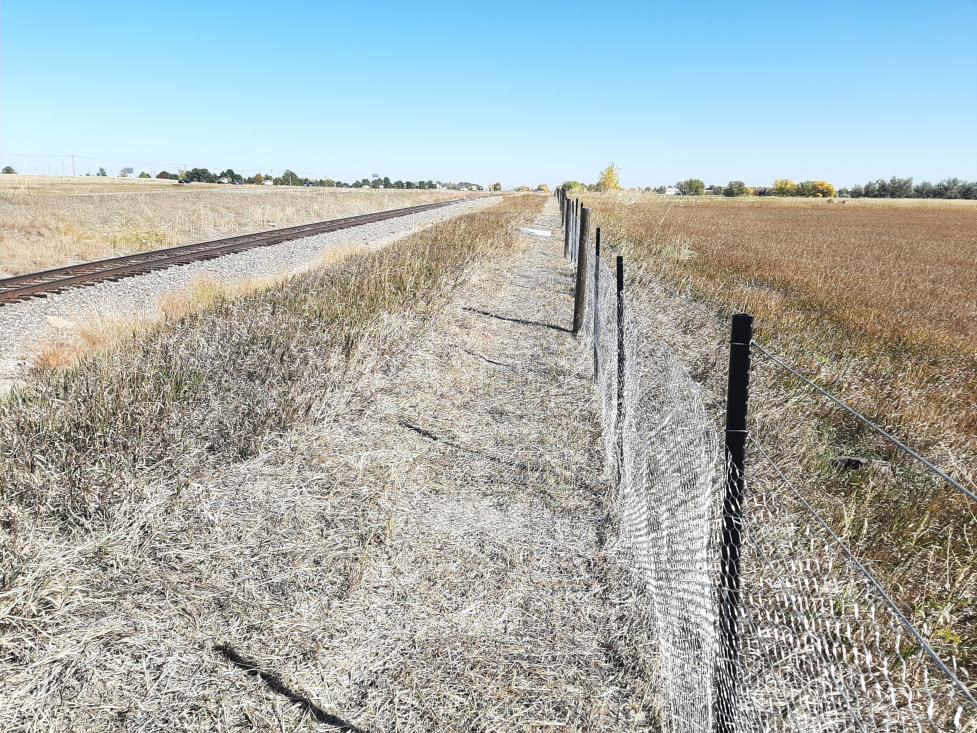
A schematic of a chicken wire barrier is below. Examples of acceptable barriers on Open Space Land can be seen along the west side of N. 71st Street, just south of the intersection of Highway 119 and Highway 52, and on the north side of Monarch Road, between N. 63rd and 55th Streets.
The following list details the barrier standards that must be followed to receive funds through this program:
Chicken Wire Barriers
- The chicken wire portion of the barrier attached to the fence must be at least 30 inches tall, but no taller than 36 inches. If it is attached to a wire fence, it must not attach to the top wire.
- The apron of the barrier must extend at least 30 inches but no more than 36 inches, be anchored to the ground, and face the prairie dog colony.
Other Barrier Types:
The vertical section of the barrier must be at least 30 inches tall, but no taller than 36 inches
- The base of the barrier must be trenched at least 36 inches deep, and/or have a 30- to 36-inch apron anchored to the ground facing the existing prairie dog colony.
- Barrier material must be durable and designed for exposure to harsh conditions including wind, snow, heat, freezing, and ultraviolet radiation. Acceptable materials include chicken wire, vinyl, shade cloth backed with hardware cloth, or metal panels. Silt fencing is NOT an acceptable barrier material. Alternative barrier types must be approved by OSMP. All barrier types must meet these requirements:
- Barriers may not be installed on an existing OSMP boundary fence that is in poor condition or where the barrier or apron is incompatible with fence maintenance, livestock management, or other OSMP uses, at the sole discretion of OSMP.
- If the barrier is not installed on boundary fence shared with Open Space Land it must be inset at least 6 feet from the boundary fence to allow the entirety of the apron to be installed on the private property and allow additional room so that there is not a tight space that can trap wildlife.
- If barrier installation will damage existing, occupied prairie dog burrows on open space land, the awardee must consult with OSMP staff for impact avoidance and potential passive relocation of the prairie dogs in these burrows prior to installation. Damaging prairie dog burrows is prohibited by City ordinance.
- Barriers must be designed to best prevent prairie dog movement based on the local landscape, including but not limited to connection to existing barriers, and reducing permeability of access areas such as gates. OSMP staff may visit each project site to provide design requirements prior to approval of the cost-share funding.
- Barriers must not contribute to collection of List A Species of noxious weeds as identified by the Colorado Department of Agriculture. OSMP staff will provide design alternatives to avoid these impacts or reject an application if these impacts cannot be mitigated.
- Barriers must not obstruct wildlife movement corridors. OSMP staff will provide design alternatives to avoid these impacts or reject an application if these impacts cannot be mitigated.
Funding Agreement
Applicants that are selected for funding will be required to enter into a Funding Agreement (“Agreement”) with the city. The Agreement will detail the requirements for receiving funding, a deadline for the use of the funds barrier specifications, and other stipulations. Even if a project is selected for funding, no work can begin until a Funding Agreement and a maintenance agreement (if the barrier is installed on a shared boundary) are signed.
Award Process
The anticipated award announcement date will be early June 2026 (subject to change). Applicants may not apply cost-sharing funds to work started or barriers installed prior to award of the funds. After a Funding Agreement and a maintenance agreement (if applicable) is signed, work for awardees can begin.
OSMP will provide the grant awards after the project is complete, a staff site visit has occurred to verify project requirements, the awardee has registered in the city’s system, and invoices/receipts have been submitted.