

The Barker Gravity Pipeline is a key part of Boulder’s water system and has been in operation for more than a century. Originally constructed in the early 1900s as part of a hydroelectric system, it continues to play an essential role in delivering water to the community today.
The City of Boulder acknowledges that it is located on the traditional territories and ancestral homelands of Indigenous peoples who have stewarded this land for generations. We honor and respect their enduring relationship with this land.
The Barker Gravity Pipeline is a key part of Boulder’s water system and has been in operation for more than a century. Originally constructed in the early 1900s as part of a hydroelectric system, it continues to play an essential role in delivering water to the community today.
The pipeline was constructed to move water by gravity from Barker Reservoir through the mountains to downstream facilities. Built across rugged terrain, the system required tunneling, steep alignments and durable materials to withstand mountain conditions. This infrastructure was designed to carry water efficiently over long distances while taking advantage of elevation changes to support hydroelectric generation.
The system was developed alongside Barker Reservoir and other facilities to generate electricity and move water through the mountains using gravity. Water travels from Barker Reservoir through the pipeline to Kossler Reservoir and onward to the Boulder Canyon Hydroelectric Facility, taking advantage of significant elevation drop to produce power.
Beginning in the 1950s, Boulder partnered with the system’s original owners to use this infrastructure for municipal water supply. Over time, the system transitioned from primarily generating electricity to serving as a critical component of the city’s drinking water system.
In 2001, the City of Boulder purchased Barker Reservoir and related facilities, ensuring local control of this important water infrastructure. Today, the Barker Gravity Pipeline continues to carry water for treatment and distribution, while still supporting hydroelectric generation when possible.
This historic pipeline reflects Boulder’s long-standing commitment to using natural systems efficiently—for both water supply and renewable energy.
Barker Gravity Pipeline

Undated, the Augusta Pipe Camp. Source: Call No. BHS 167-1-2 Photo Album, Boulder County Hydroelectric Project, 1906-1910 Collection; Boulder Public Library – Carnegie Library for Local History.
1 of 10

November 1909, the gravity pipeline at the point where it enters Tunnel 2. Source: Call No. BHS 167-1-1-D, Boulder County Hydroelectric Project, Pipe Construction and Laying Collection; Boulder Public Library – Carnegie Library for Local History.
2 of 10

Undated, a man standing near sections of pipe being hoisted by the tram system. Source: Call No. BHS 167-1-1-D, Boulder County Hydroelectric Project, Pipe Construction and Laying Collection; Boulder Public Library – Carnegie Library for Local History.
3 of 10

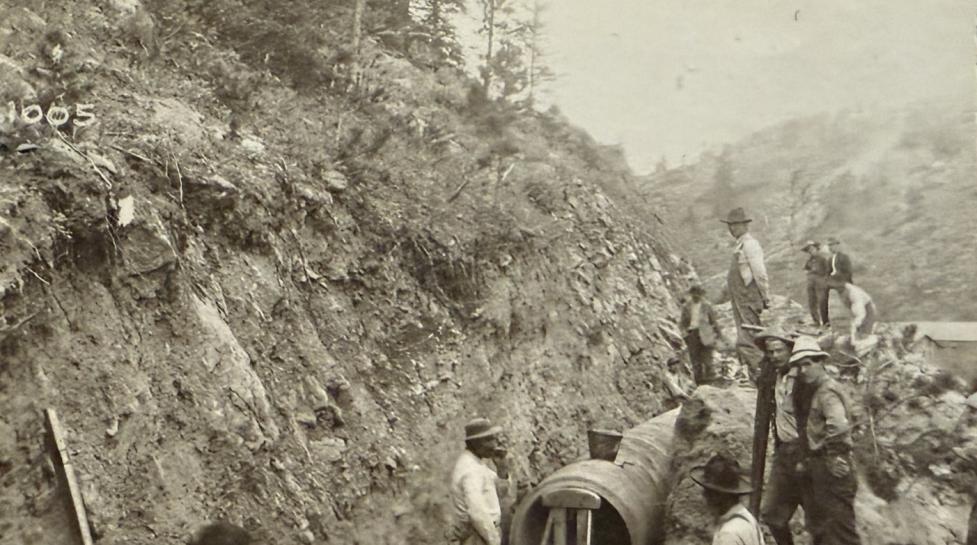
Undated, the gravity line under construction. Source: Call No. BHS 167-1-2 Photo Album, Boulder County Hydroelectric Project, 1906-1910 Collection; Boulder Public Library – Carnegie Library for Local History.
4 of 10

November 1909, workers laying the gravity pipeline. Text on the back of the photograph reads “Laying 36 inch pipe concrete…most of these men are inspectors.” Source: Call No. BHS 167-1-4, Boulder Hydroelectric Company Collection; Boulder Public Library – Carnegie Library for Local History.
5 of 10

Overview of Barker Gravity Pipeline - Pipeline Detail and Tunnel 4, view to the South
6 of 10

Overview of Barker Gravity Pipeline - Rock Retaining Wall, view to the Southeast
7 of 10

Overview of Siphon 7, view to the Northwest
8 of 10

Overview of Barker Gravity Pipeline - Foot Trail, view to the South
9 of 10

Overview of Rock Retaining Wall and Catch-Basin, view to the Southeast
10 of 10


