Managing Limited Public Parking

This project will provide transportation alternatives and test new street parking strategies in a high-demand neighborhood. The goal is to create a system where neighborhood residents can reliably park near home, and where students who truly need to drive have a legal option to park occasionally.

Project Overview

Goss Grove is a neighborhood where many different daily routines overlap — residents heading to work, students traveling to high school and university classes, customers visiting local shops, and more.

With so many destinations, demand for parking is often high. In a place that has very limited street parking — only about 404 street parking spots — this demand is high enough that the neighborhood often simply doesn’t have the space.

City Council approved a two-year pilot project to try a new approach for managing limited street parking in combination with free transit passes. The pilot will begin this summer, before the next school year starts.

We know people are feeling the pressure today, and the goal is to understand what actually works in practice — not just make assumptions. While the city cannot eliminate parking demand or guarantee that a space will always be available, our goal is to help better manage demand while expanding access to transit. Over the next two years, we hope to learn:

  • Whether parking demand changes once pricing is introduced.
  • Whether the program can pay for itself.
  • Whether people change how they travel to and from the area.
  • What residents, students, and other community members experience from the pilot overall.

The pilot gives us room to adjust as we learn from real-world experience.

decorative graphic

What’s new — and what’s not

Previously, the city managed parking demand through the Neighborhood Parking Program (NPP). Some familiar parts of the parking system will remain in place.

What's new

Hourly paid parking with no time limits for people who don’t have a permit from 8 a.m. to 6 p.m. on weekdays:

This means people can stay as long as they need, but the cost helps encourage those who have other travel options —
like transit, biking, or walking — to consider using them instead of driving.

Neighborhood residents will receive free EcoPasses funded by parking fees.
This provides another travel option for times when transit may work for their trips.
Previous challengesFree parking for up to two hours, once per day, for people without a permit from 8 a.m. to 6 p.m. on weekdays.
After those two hours, they could not park anywhere in the Goss Grove Neighborhood Parking Permit zone.
Only people with resident, business, or commuter permits could stay longer.
No EcoPass.
What’s not changing
  • Permit and pass options and prices will stay the same.
    This includes flex permits & day passes, and resident, commuter and business NPP permits.
  • Students from Boulder High School and CU Boulder will continue to have access to free transit.
  • The parking system is designed to pay for itself.

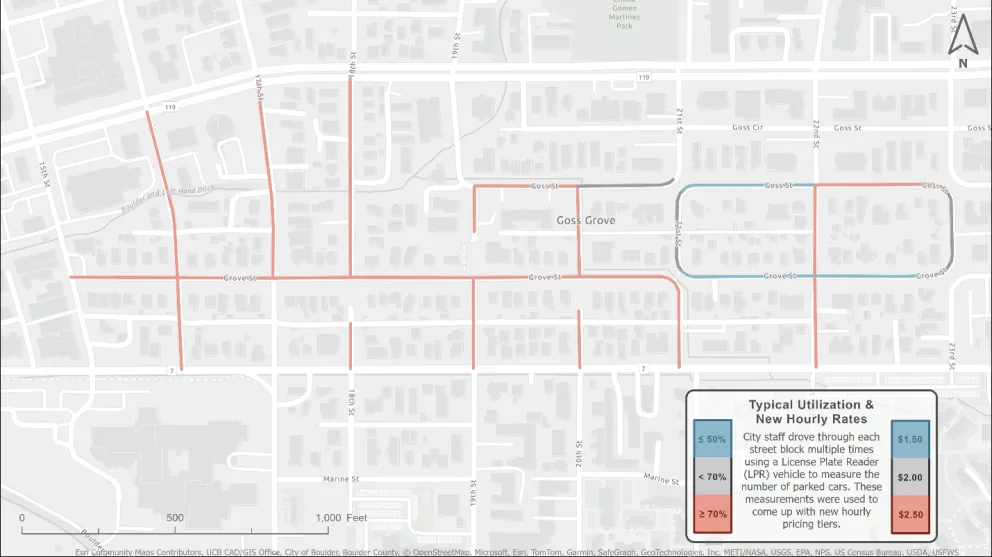
To set fair prices for the pilot, parking occupancy patterns informed hourly rates: how full each block typically is during school-year weekdays.

Based on actual demand, prices were generally set between $1.50 and $2.50 per hour.

While there will be a cost for student parking under the pilot, this option is intentionally priced for occasional use — not as a daily replacement for the limited spaces on school grounds.

Map of the Goss Grove neighborhood showing typical utilization of on-street parking and the pricing associated with the pilot. Utilization below 50% is displayed in blue and is priced at $1.50 per hour. Utilization between 50 and 70% is shown in grey and is priced at $2.00 per hour. Utilization over 70% is shown in red and is priced at $2.50 an hour.
decorative graphic

Community Input

Throughout the pilot, we will be listening closely to residents, students and others who park in the neighborhood. The goal is to ensure that a variety of perspectives are considered as we evaluate the pilot in balance with equity, fiscal responsibility, and mobility goals.

Next Steps

We encourage everyone who parks in the Goss Grove neighborhood — and parents of students who park nearby — to complete our community questionnaire and share it with others who are affected. Your experiences will help improve the pilot over the next two years, and shape future parking programming.

Questionnaire

decorative graphic

What we’ve heard so far

Multiple groups rely on the same limited public space. Both Goss Grove Residents and students and families attending Boulder High School have provided feedback that how parking is managed in Goss Grove today is not effective or fair

A community meeting was held on May 18 with Goss Grove residents, Boulder High School families, and those who park in the Goss Grove neighborhood.

  • Being unable to find parking near their homes.
  • Difficulty getting in and out of their homes on school days.
  • Spillover parking from the school and nearby attractions making it hard for them and people visiting them to reach their house.
  • Unsafe parking behavior such as vehicles blocking driveways and traffic congestion from people searching for parking.
  • Students leaving trash behind in the neighborhood.
  • Upcoming new residential developments will place additional pressure on the neighborhood's limited parking supply.

  • Limited parking permits available at Boulder High School.
  • The cost of parking and parking violations.
  • Limited affordable parking alternatives nearby.
  • Little to no transit service where they live.
  • After-school activities requiring a car to get to and a place to store athletic gear during the day.
  • The additional time it takes to take transit instead of driving.
  • Safety concerns of using transit after dark.
  • Students reselling parking permits.
  • Students having to move their car after 2 hours under the current system.
  • Student safety downtown and around Boulder High.
  • Students rushing out of class every two hours to move their cars under the existing time limit.

Participants brought forward ideas ranging from small improvements to long‑term visions. While the pilot cannot implement all these changes, feedback is still incredibly useful — your input helps shape future parking discussions and shows what matters most to the neighborhood.

  • A larger Park-and-Ride on the North side of Boulder.
  • Partner with local businesses to encourage the sale of parking permits to students in nearby lots or garages with availability.
  • Reduced fees for Boulder High School students in the downtown garages.
  • Weighted lottery for Boulder High School parking permits based on proximity to school/after-school activities/carpooling/ need-based.
  • Carpooling options for students.
  • Incentivizing smaller cars.
  • Boulder High sponsored community service to pick up trash left behind in the Goss Grove neighborhood.

Many of these ideas have already been considered by the city and Boulder High School and are addressed in the FAQ section below. We hope community members continue sharing ideas. You can continue to submit other ideas online.

decorative graphic

Frequently Asked Questions

We’ve heard from residents and families who want to know whether the pilot will affect the permit types they rely on today. At this time, Goss Grove permit options and prices are not changing as part of the pilot.

The pilot focuses on testing new approaches to managing nonresident, non-permit on-street parking while keeping existing Goss Grove permit types stable. As we learn more from the pilot, we may explore adjustments—but any changes would be shaped by community input and real-world experience.

If you don’t have a parking permit, you can pay the hourly rate through the ParkMobile app. To learn more about parking permit options for non-residents, you can visit our permit option webpage.

The current system is causing daily challenges for both residents and Boulder High School families.

The neighborhood’s parking program was designed years ago to address spillover from downtown commuters—a problem that has largely faded. Meanwhile, demand has increased for parking in a neighborhood that doesn’t have the space.

  • Goss Grove is a small neighborhood with limited curb space — about 404 legal parking spots in total. Many homes do not have driveways or garages, so most residents depend on the street for daily parking. There are currently 349 active residential permits, which means there is very little room left for public or student parking.
  • Boulder High has 153 parking spaces, but received 318 senior parking applications last year, leaving more than half of the students without a school-issued spot. Changing enrollment patterns mean more students travel from farther away and don’t always have reliable transit or bike options. At the same time, current neighborhood rules only allow two-hour parking for anyone without a residential permit. That means students currently cannot legally park all day in Goss Grove under the existing system.

The neighborhood experiences circling, congestion, and blocked driveways because curb space is so limited.

Overall, there simply isn’t enough space to meet everyone’s needs, which is why we’re testing a more balanced approach.

According to BVSD, the current transportation mode share for Boulder High School is:

  • 12% biking and walking 
  • 5% carpool 
  • 18% school bus 
  • 21% RTD 
  • 42% car (including both self-drive and drop off) 

As of the 2025-2026 school year, there were 504 students eligible to take the school bus, but a point-in-time survey captured only 220 riding it on a given day.

Schoolpool

BVSD has partnered with the Denver Regional Council of Governments (DRCOG) to provide their SchoolPool program. This secure matching system connects families going to school and back. Use it to plan carpools, walking groups, bike trains, or to find other students to ride either RTD or the school bus together.

Safe Routes to School

Find all travel options and more resources, including parking information, at:

Any change — especially one that may introduce a cost for some families — can feel frustrating. We know many families are looking for affordable, predictable options for days when students need to drive. A few alternatives exist, but there are also important limits on where student parking can be offered.

LocationParking Options
Boulder High SchoolFor more resources about Boulder High transportation options, please visit the BVSD Safe Routes to School page.
RTD Park-n-RideVehicles registered within the RTD district can park for free at any Park-n-Ride and take the bus the rest of the way.
Public parking
  • Boulder’s public parking map provides a full list of city-managed parking locations and rates.
  • Hourly or daily parking in downtown garages can be an option, but we know the jump to the daily rate after 6 hours creates affordability concerns for families.
  • Additional information about parking permit options can be found through the city’s parking guide page.
Private lots near the school Some parents have asked whether businesses or private property owners could make unused spaces available. Many private lots already offer paid permits directly to the public, and parents who are interested can check with those lot or garage owners individually.
  • Why students cannot buy permits in downtown garages: Downtown garages are owned by the Central Area General Improvement District (CAGID), which funded them through district property taxes. Although the city manages the garages day-to-day, it does not set the rules for whether or not student permits can be offered.

    Because of that funding model, longstanding policy limits permit eligibility to employees who work within the district.

  • Why students cannot use the nearby 14th Street lots: The 14th Street lots near Boulder High School are being redeveloped under the Civic Area Plan, so they are not a workable long-term parking option.

Why the pilot introduces an occasional use option instead:

Right now, students cannot legally park all day in Goss Grove at all because of the two-hour time limit.

The pilot creates a new, legal option for students who occasionally need to drive. It is intentionally priced for occasional use — not as a daily replacement for school lot permits or alternative transportation.

We understand why this question comes up—demand is high, and families want more predictable options. Unfortunately, Boulder High School has very limited ability to add parking on campus. Because the school sits in a current floodplain, state and local regulations prevent adding new impermeable surface, including new parking lots.

Parking garages are also not feasible in this context. They are extremely expensive to build and maintain, typically costing upwards of $100,000 per space to construct, plus ongoing annual maintenance of 2–4 percent of the total amount.

This means the pilot is focused on managing the curb space that already exists, rather than expanding it.

The City of Boulder is responsible for managing the public right-of-way, which includes the streets and on-street parking in the Goss Grove neighborhood. The pilot focuses only on how we manage that public, on-street space.

The project does not change how parking works on private property. Boulder High School is responsible for managing all parking and transportation options on its own school property. This includes deciding how many student permits to offer, how their on-campus parking lots are used, and what transportation support they provide to their students.

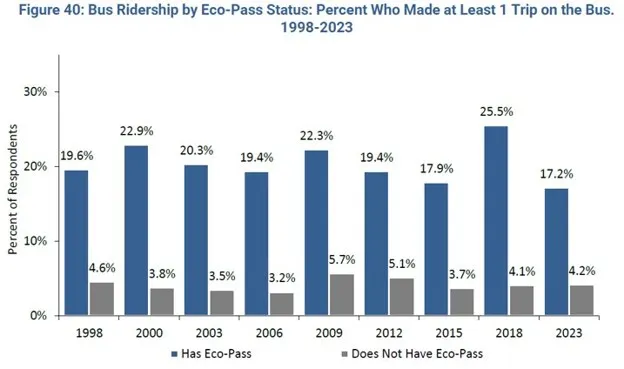
Parking management works best when people have options. Local survey data from the past several decades show that community members who have an EcoPass are nine times more likely to use transit than those who don’t.

By pairing paid parking with free EcoPasses for neighborhood residents, the pilot gives people more flexibility in how they get around.

The money collected from permits and paid parking will help cover the cost of providing EcoPasses at no cost to residents. This approach aims to:

  • Give residents more travel choices beyond driving.
  • Make it easier for some trips to happen without a car.
  • Increase use of public transit in pursuit of citywide mobility and safety goals.
  • Assess whether parking revenue can help support transit passes. To keep the program running, it needs to pay for itself. Parking revenue supports things like permit administration, enforcement and the EcoPass benefit.

EcoPasses can have a big effect on how people choose to get around. When people have free, unlimited access to transit, they tend to use it much more — and drive less.

Research from Boulder shows that:

  • People with an EcoPass are much more likely to ride the bus.
  • Residents with an EcoPass drive alone far less often than residents without one.
  • EcoPass holders drive alone less overall and are almost twice as likely to walk or bike for everyday travel.

These changes in travel habits add up to meaningful environmental benefits. On average:

  • A Boulder resident with an EcoPass produces about 30% to 40% fewer transportation-related emissions than someone without a pass.
  • Residents with an EcoPass emit significantly less CO₂ each year — roughly one metric ton less per person.
  • Commuters with an EcoPass cut their emissions by more than half compared to those who drive alone.

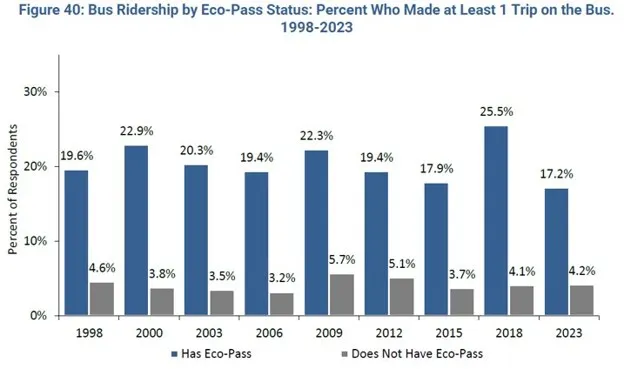
This graph shows bus ridership by eco-pass status for Boulder residents between 1998 and 2023. It shows that residents who do have an ecopass are significantly more likely to make at least one trip on the bus than residents without an ecopass.

We considered Neighborhood Parking Permit (NPP) zones citywide for the pilot. The Goss Grove neighborhood, located across Arapahoe Avenue from Boulder High School north to Canyon Boulevard, and between 15th and Folsom streets, met the following conditions:

  • High housing density.
  • High parking demand.
  • Close to activity centers such as schools, businesses and parks.
  • Transit access, including bus stops and different bus routes.

Because of these factors, Goss Grove was chosen for the pilot program, which will help better manage demand and provide more transportation choices.

Over the years, many community members have engaged with this topic through neighborhood conversations, City Council processes, and broader transportation planning efforts. This pilot is part of that ongoing process — not the beginning of it.

Introducing mobility benefits into the Neighborhood Parking Permit (NPP) program was included in a City Council-adopted five-year implementation plan. That commitment was made several years back, and we are now in year six. The Goss Grove pilot is one of the programs where that plan is being tested on the ground.

This work builds on nearly a decade of updates to Boulder’s parking and access programs. In 2017, council adopted the Access, Management, and Parking Strategy (AMPS), which set the City’s direction by introducing the following policies: provide for all transportation modes, customize tools by area, support a diversity of people, seek solutions with co-benefits, and plan for the present and future. Those policies still guide our work today.

At the same time, your lived experiences matter, and we understand that community needs evolve. The pilot is designed to continue the conversation, not replace it. Throughout the two-year period, we will be talking with residents, students, and others who park in the neighborhood to understand what is working, what isn’t, and where adjustments are needed.

The goal is to learn in real time so the long-term system reflects both the city’s adopted direction and the day-to-day realities in Goss Grove.

We explored several options before landing on the current pilot, and each came with real tradeoffs. Residents and Boulder High families shared concerns on all sides, and we worked to balance those needs as carefully as possible.

One option was low pricing with no time limits. This would have made parking easier for students, but based on what we heard from neighbors, it likely wouldn’t protect enough space for residents or other users who rely on curb parking every day.

Another option was high pricing paired with strict time limits. This would reduce driving effectively, but it would also make things extremely difficult for students who genuinely need to drive—especially during the school day, when leaving class to move a car simply isn’t realistic. We do not want to put students in that position.

The pilot starts with demand-based pricing and no time limits. This approach lets price adjust based on how full each block tends to be, similar to how we manage demand downtown. Blocks with higher demand are priced higher; blocks with lower demand are priced lower. This gives people choices—some prioritize convenience, others prioritize affordability.

We also chose not to start with time limits because we want to preserve a legal option for students who occasionally need to drive. It’s true that there will be a cost, but this option is intentionally designed for occasional use, not everyday parking. On most days, we encourage students to use other travel options that work for them.

This balanced approach allows us to protect residents’ access, provide students with a workable occasional option, and gather meaningful data to guide future improvements.

Permits cannot be resold. Anyone suspected of permit transferring or reselling is subject to revocation of the permit.

Throughout the two-year period, we’ll be tracking a variety of information so we can see the full picture of what’s working and what isn’t.

Numbers we’re measuring include:

  • Parking availability for residents, students, and visitors.
  • Transit use, including whether EcoPasses help more residents choose the bus when it works for their trip.
  • Safety issues such as blocked driveways, fire hydrants, and crosswalks.
  • Financial sustainability of the pilot, including support for the EcoPass benefit.

Community feedback is just as important. We will be engaging directly with residents, students, and others who park in the neighborhood to understand their lived experience—what feels easier, what feels harder, and where the system needs adjustment.

The pilot is designed to evolve. As we learn from both data and community experience, we will make changes to improve the program.

decorative graphic

Managing public street parking

City streets serve the parking needs of residents, visitors, employees and employers. The city’s role is to manage that space effectively, equitably and transparently.

In some neighborhoods in Boulder, the number of people who want to park can exceed the available space. While the city cannot expand the amount of parking available in neighborhoods, it can help balance competing uses for limited street parking.

Parking management tools such as pricing, time limits and permits can help:

  • Reduce congestion caused by circling for parking.
  • Improve turnover of parked cars where appropriate, like near businesses and parks.
  • Encourage different transportation choices.
  • Better align demand with available space.

Learn more at:

Latest Events