

The City of Boulder is committed to digital accessibility. Some content may not be fully accessible due to technical limitations or issues. For alternate formats or accommodations, please visit Accessibility | City of Boulder or contact accessibility@bouldercolorado.gov.
City of Boulder Landscape Manual
The City of Boulder Landscape Manual sets standards for landscaping and irrigation design, installation, maintenance and management for all sectors involved in new development and redevelopment projects.
Accessibility Statement
Introduction
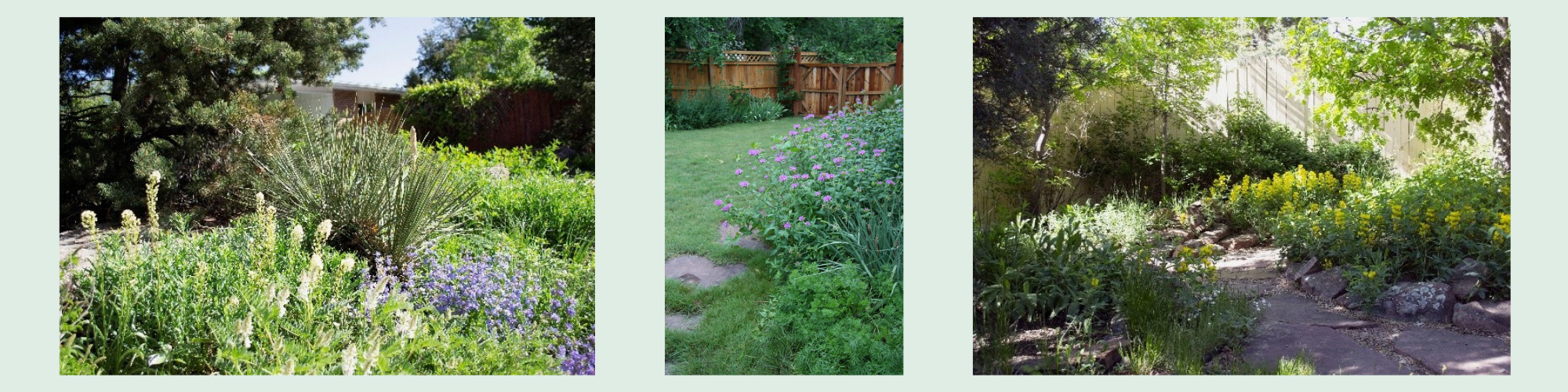
Photos courtesy of David Sutherland
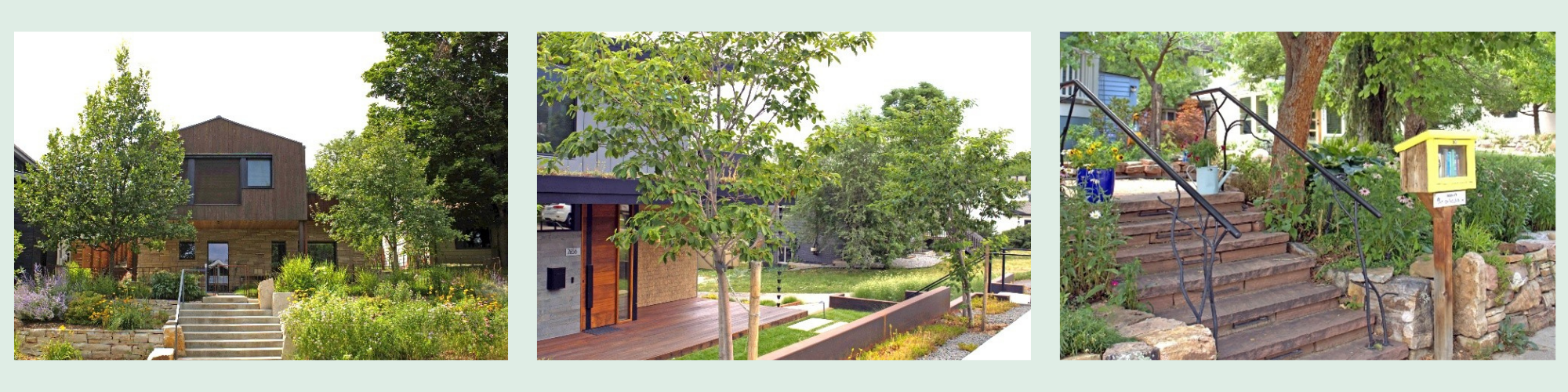
These established landscapes require no irrigation
The City of Boulder Landscape Manual establishes standards for landscaping and irrigation system installation, design, maintenance and management in the City of Boulder for governmental agencies, design professionals, private developers, community groups, property managers, and homeowners for new development and redevelopment projects. These standards promote sustainable, attractive, colorful and diverse landscapes and efficient use of water for irrigation within the city. These standards alsobalance the goals of expanding the city’s tree canopy for a number of environmental benefits including but not limited to stormwater runoff reduction, carbon sequestration, energy savings and mitigating the urban heat island. The standards and the Approved Tree and Plant List also ensure that only approved plants and trees are planted and maintained that are wildfire resistant or have low flammability to deter the spread of wildfires into the city.
This manual establishes requirements in conjunction with the Boulder Revised Code provisions on water use, wildfire mitigation and landscaping quality, and with the Design and Construction Standards for public rights-of-way. The manual also advances and enforces the objectives of the city’s Water Efficiency Plan and Community Wildfire Protection Plan.
Goals and Purpose of this Manual
The goals and purpose of this manual are outlined in Section 9-9-12, “Landscaping and Screening Standards,” B.R.C. 1981. Overall, quality and efficient landscaping is intended to enhance the visual appearance of developments, ensure healthy resilient landscapes, and mitigate urban heating resulting from development and surface treatments.
This manual is also intended to prevent and deter the spread of wildfire through use of fire resistant and low flammability vegetation and maintenance practices that may include the removal of high-risk vegetation and avoiding plantings near structures in areas of the city that are at high risk for wildfire spread.
Lastly, this manual is intended to promote the efficient use of water resources in the landscape to support long-term sustainability of the city’s water supply and improve drought resilience.
Applicability and Process
- A. This manual applies whenever a project requires a landscape or irrigation plan pursuant to the Boulder Revised Code, including Subsections (A) and (B) below.
- A landscape and irrigation plan are required for any building permit associated with new development or redevelopment on private property meeting the threshold requirements of Section 9-9-12(b), “Landscaping and Screening Standards,” B.R.C. 1981.
- Landscape plans may also be required pursuant to any project being reviewed pursuant to Section 9-2-14, “Site Review,” B.R.C. 1981, Section 9-2-15, “Use Review,” B.R.C. 1981 or Section 9-2-16, “Form-Based Code Review,” B.R.C. 1981.
- B. Landscaping and irrigation systems shall be installed and maintained in accordance with the following, in order of compliance:
- The Boulder Revised Code, specifically, the City of Boulder landscaping regulations of Section 9-9-12, “Landscaping and Screening Standards,” B.R.C. 1981, Section 9-9-13, “Streetscape Design Standards,” B.R.C. 1981, and Section 9-9-14, “Parking Lot Landscaping Standards,” B.R.C. 1981;
- The City of Boulder Design and Construction Standards in the public right-of-way;
- This manual; and
- The Boulder Approved Tree and Plant List.
- C. Landscape plans and irrigation plans must meet the requirements of this manual. This manual covers specifications on:
- Soil and Mulch;
- Turf, Trees, and Plants;
- Wildfire Resistance and Defensible Space;
- Water Conservation and Efficiency;
- Irrigation Requirements; and
- Landscaping Maintenance.
- D. If there are any conflicts between this manual and the Boulder Revised Code, the Boulder Revised Code shall prevail.
Section 1. Definitions
In the event of any conflict of these definitions with the Boulder Revised Code, the applicable definition in the Boulder Revised Code shall apply.
- Compost: Fully finished, stabilized, and mature organic material derived from sources such as leaves, grass clippings, organic food waste, wood chips, and other yard wastes. Finished compost is dark, crumbly, earthy in smell, and does not resemble the original feedstock materials.
- Common interest community: This term shall have the same meaning as defined in the Colorado Revised Statutes Section 38-33.3-103 (8).
- Control valve or station: A device that regulates the flow of water within an irrigation system.
- Defensible space: This term shall have the same meaning as defined in the City of Boulder Wildland Code adopted in Chapter 10-8.5, “Wildland Code,” B.R.C. 1981.
- Drip irrigation: A low-pressure irrigation method that delivers water directly to the soil through drip emitters, including micro-spray systems.
- Establishment or establishment period: The time required for a plant to seed, germinate, and develop a healthy root system, which promotes long-term health and growth.
- Hydrozone: A portion of the irrigated landscaped area in which plants with similar water needs are grouped and served by the same irrigation valve or set of valves with the same irrigation schedule.
- Ignition Risk Areas: The designations on the city’s official map of the Wildland Urban Interface (WUI) area.
- Landscape plan: Landscaping and irrigation design plans that meet all requirements of Section 9-9-12, “Landscaping and Screening Standards,” B.R.C. 1981 and this manual that are submitted to the City of Boulder for review and approval prior to landscaping and irrigation work being completed.
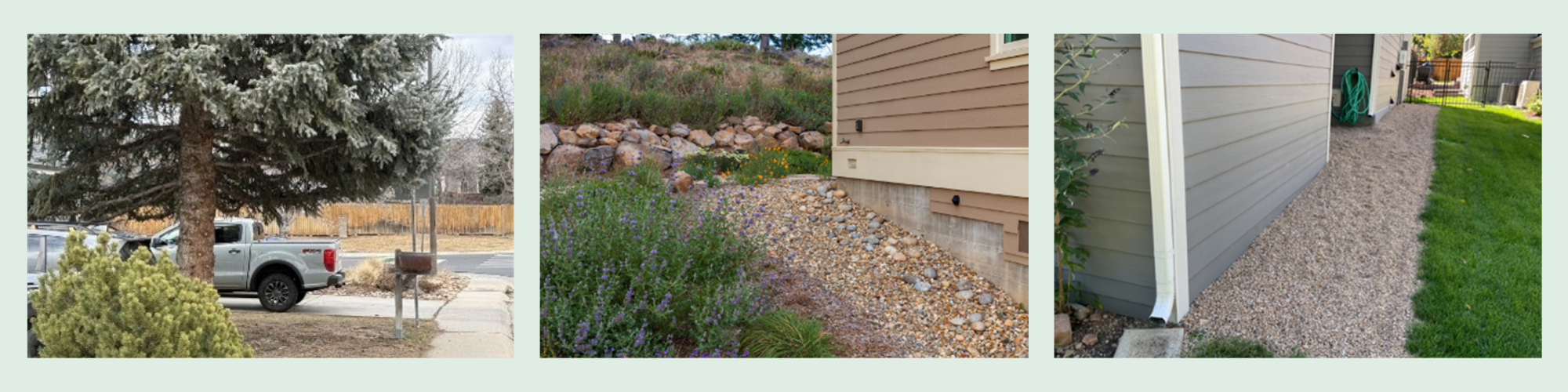
- Landscape rock: Loose rock material greater than ¼ inch in size used as an aesthetic or functional element, such as a path or downspout splash block.
- Landscaped area: This term shall have the same meaning as defined in Chapter 9-16, “Definitions, B.R.C. 1981 of Title 9, Land Use Code.
- Mulch: Non-living organic or inorganic material, such as chipped wood or rock material ½ inch or less in size, applied to the surface layer of a planting bed in a loose condition to retain moisture, suppress weeds, and improve soil quality.
- Mulch, squeegee: An inorganic mulch that is 1/2” or less gravel with no fines.
- Noxious weed: A plant or parts of a plant that have been designated by Colorado state regulations as a noxious weed.
- Overspray: Irrigation water that is delivered beyond the target/intended area.
- Planting bed: An area where trees, shrubs, vegetables, annuals, perennials, fruit, herbs, or ornamental grasses are cultivated.
- Sprinkler/overhead irrigation: An irrigation method that distributes water through the air using devices such as spray heads, rotors, or pop-ups.
- Temporary irrigation: A temporary watering system designed to transport and distribute water to landscape plants.
- Tree ring: A circular mulched area around a tree trunk.
- Turf: Turf is continuous plant coverage consisting of nonnative grasses or grasses that have not been hybridized for arid conditions and which, when regularly mowed, form a dense growth of leaf blades and roots.
- Turf, artificial: Artificial turf means an installation of synthetic materials developed to resemble natural grass.
- Turf, functional: Functional turf is turf that is located in a recreational use area or other space that is regularly used for civic, community, or recreational purposes, which may include a playground, a sports field, a picnic ground, an amphitheater, a portion of a park, and the playing area of a golf course, such as a driving range, chipping and putting green, tee box, green, fairway, and rough.
- Turf, functional artificial: Functional artificial turf is artificial turf that is:
- A. located in a recreational use area or other space that is regularly used for civic, community, or recreational purposes, which may include a playground, a sports field, a picnic ground, an amphitheater, a portion of a park, and the playing area of a golf course, such as a driving range, chipping and putting green, tee box, green, fairway, and rough; or
- B. a component of a product designed and approved by a professional engineer for civil infrastructure projects, including but not limited to:
- covers for solid waste facilities and brownfield sites; and
- revetments for slopes, channels, levees, and dams.
- Turf, non-functional: Non-functional turf is turf that is not functional turf.
- Turf, non-functional artificial: A non-functional artificial turf is turf that is not functional artificial turf.
- Wildland Urban Interface (WUI): The area of the city that is subject to City of Boulder Wildland Code pursuant to Chapter 10-8.5, “Wildland Code,” B.R.C. 1981.
Zone, Home Ignition: The area around buildings and structures on a lot or parcel that is subject to noncombustible zone or defensible space requirements within the Wildland Urban Interface (WUI).
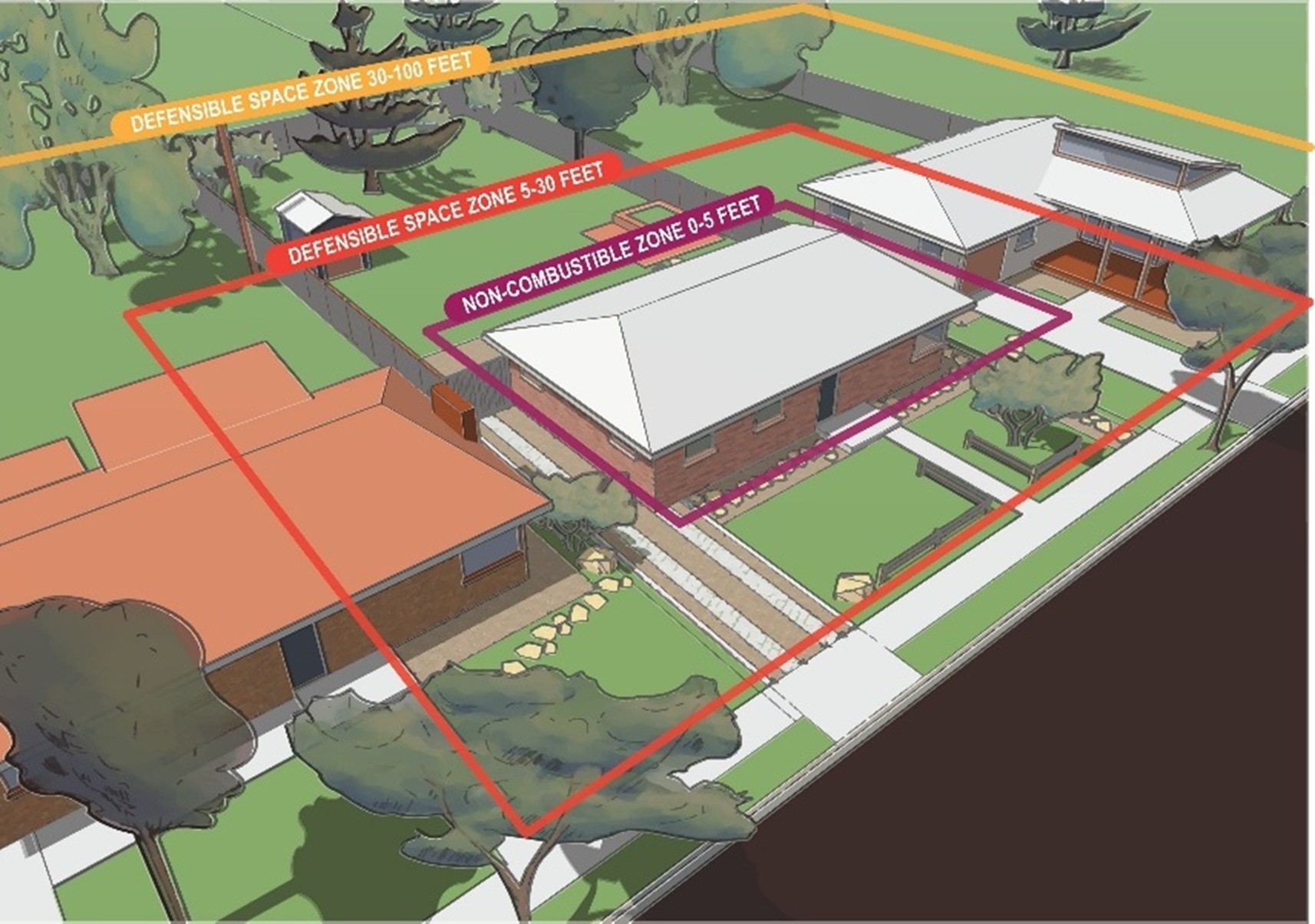
Home Ignition Zones, including the 0-5 foot noncombustible zone and defensible space.
- Zone, Irrigation: Typically, an area served by a single control valve, sometimes referred to as a “station.” Zones are comprised of plant materials and soil types with similar water requirements.
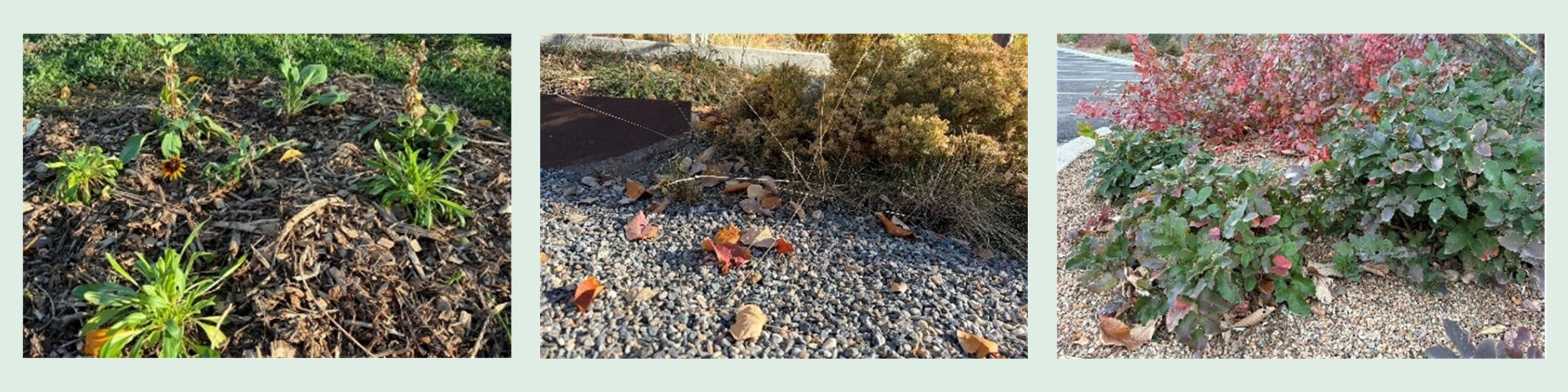
2.1 Soil Preparation and Amendments
- A. Site preparation and all planting shall be completed in accordance with the City of Boulder Design and Construction Standards. Site preparation shall include tilling the soil to a minimum depth of six inches below the finished grade, together with soil amendments, including, without limitation, compost and manure that are appropriate to ensure the health and sustainability of the landscaping to be planted.
2.2 Mulch and Landscape Rock Standards
- A. Purpose: The objective of mulch is to improve water retention, reduce weeds, reduce heat in the landscape, improve soil structure, and improve plant health. Mulches appropriate for use in the Wildland Urban Interface also reduce the potential for the spread of fire in the landscape.
- B. Landscape Rocks: Use of rock in landscape areas must meet the following:
- Landscape rock greater than ½” in diameter are prohibited in planting beds.
- Landscape rock greater than 3 inches in diameter are prohibited in the public right-of-way and within 18 inches of a sidewalk.
- C. Mulch Requirements: Mulches are required in all shrub, tree, and perennial planting beds, unless the planting beds are established using seed or sod. In the Wildland Urban Interface area, mulches shall be installed consistent with the standards in Table 2-1.
Table 2-1: Mulch Requirements in the Wildland Urban Interface Area
Mulch Type | WUI Requirements | |
|---|---|---|
| (all loose material mulches to be installed 3” deep) | Ignition Risk Areas1 IR-1, IR-2, and IR-3 | Home Ignition Zones Noncombustible zone and defensible space |
| Inorganic: Squeegee (1/2” or less gravel with no fines) | Allowed in all areas | Allowed in all zones |
| Organic: Aged Arbor Chip Mulch ( 1 ½” max particle size) | Allowed in all areas | Prohibited in noncombustible zone |
| Organic: Organic mulches other than Aged Arbor Chip (such as cedar bark, or shredded gorilla hair) | Prohibited in all areas | Prohibited in all zones |
| Living: Short Native Colorado Grasses or Low Creeping Groundcovers | Allowed in all areas | Prohibited in noncombustible zone |
Table 2-2: Mulch Recommendations
Material | Planting Use | Irrigation Type | ||
|---|---|---|---|---|
Mulch Type | Tree Rings | Native Plants | Drip Irrigation | Spray Irrigation |
| Inorganic: Squeegee (1/2” or less gravel with no fines) | No | Yes, improves soil for natives | Yes | No |
| Organic: Aged Arbor Chip Mulch (1 ½” “ max particle size) | Yes, improves tree health | Yes | Yes | Yes |
| Organic: Organic mulches other than Aged Arbor Chip Mulch such as cedar bark, or shredded gorilla hair | Yes | Yes | Yes | Yes |
| Living: Short Native Colorado Grasses or Low Creeping Groundcovers | Yes | Yes | No | Yes |
- D. Mulches in the WUI: Mulches installed in the WUI must be one or more of the following:
- Organic: Arbor Chip Mulch - 1-1/2” maximum particle size with mixed sources (small sticks, leaves, bark, and wood chipped) aged in a pile to increase water retention properties.
- Inorganic: Squeegee - 1/2” or less gravel no fines. This mulch is acceptable in areas where noncombustible, inorganic mulch is required.
- Living: Short native Colorado grasses or creeping groundcover. They must be low-growing, low water use native grass and forb mixes.
- E. Prohibited mulches: Recycled rubber, other synthetic petroleum-based products, pine straw, or dyed mulches are prohibited for landscape use.
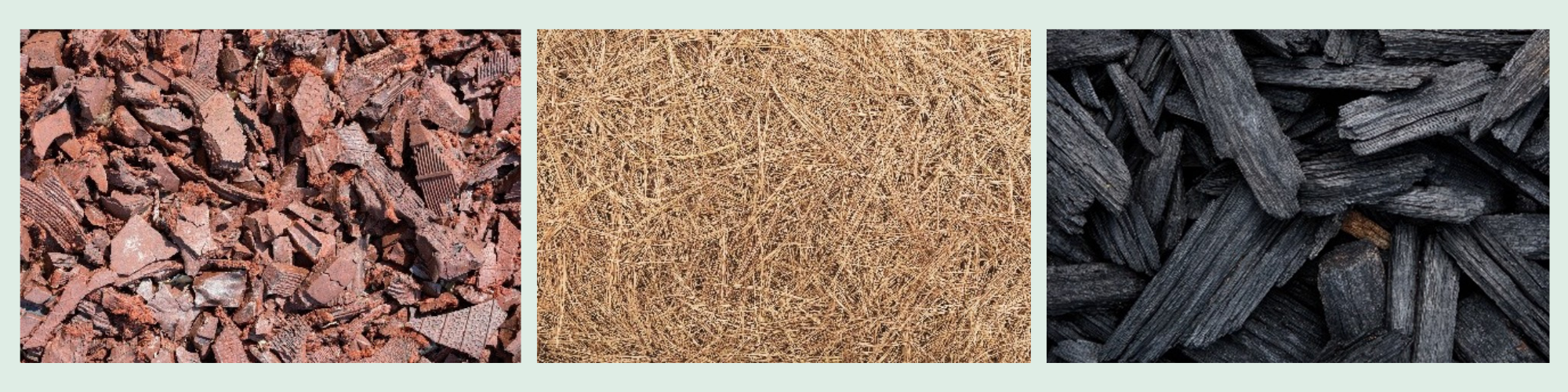
Examples of prohibited mulches: rubber mulch, pine straw and dyed mulch
- F. Mulch depth: A minimum depth of 3 inches of mulch shall be installed and maintained in planting beds, with careful placement and adjustment of depth near plant stems as needed to allow unimpeded plant establishment and vigorous growth.
- G. Tree rings: All trees must be provided with tree rings of at least 3 feet in diameter in size except that tree rings around evergreen trees must extend to the dripline of the tree.
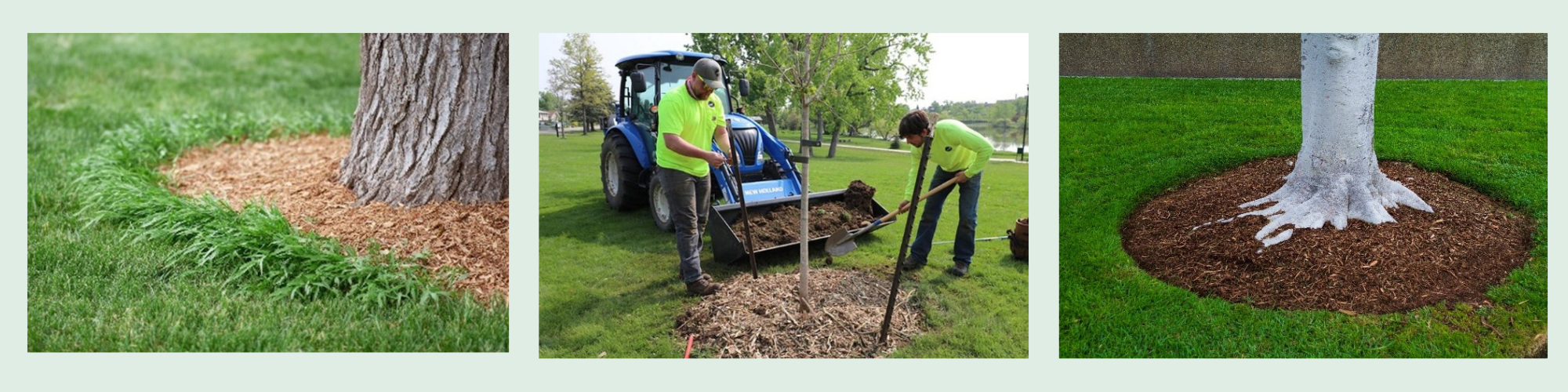
Example tree rings
- H. Mulch installation: Mulch shall be installed so that the top of the mulch is flush with the top of the curb, sidewalk, edging or sod that it is adjacent to.
- I. Squeegee mulch: Inorganic mulch is prohibited in landscape areas in planting beds, except squeegee mulch which is a gravel less than 1/2” in size without fines. Landscape rock may not be used as mulch.
3.1 Turf Requirements
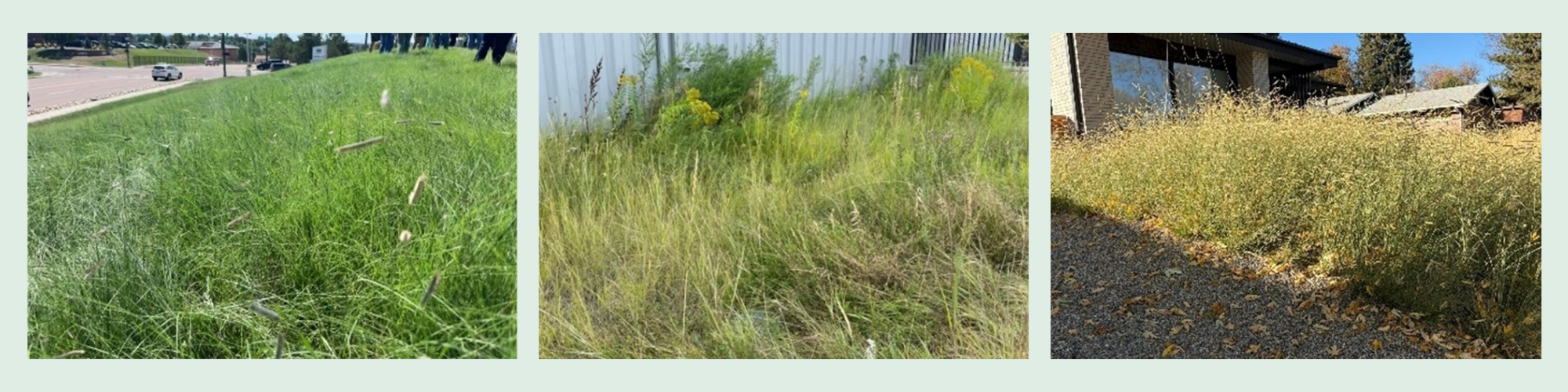
- A. Restricted turf: The following turf grass species are prohibited except in functional turf areas:
- Cool season non-native turf grasses
- Kentucky Bluegrass, including blends and hybrids
- Tall Fescue
- Fine Fescue
- Perennial Ryegrass
- Texas Hybrid Bluegrass
- Hybrids of the species above, including those selected for “drought” or “heat” tolerance
- Cold hardy Bermudagrass
- B. Non-restricted turf: The following turf grass species are allowed in all areas:
- Native and climate adapted grasses
- Buffalograss
- Blue grama grasses
- Buffalograss/blue grama grass mixtures
- Native shortgrass prairie mixtures
- Other native and low water use grasses, including mixes
- C. Additional turf requirements: Turf shall be installed in accordance with the following requirements:
- Non-functional turf is prohibited on:
- Residential lots or parcels with more than three dwelling units;
- Properties with commercial, industrial, public, or institutional land uses;
- Land within any public right-of-way; and
- New common areas within common interest communities.
- Functional turf greater than 25% of the total landscape area on a lot or parcel is prohibited, except in recreational areas such as parks and ballfields, within cemeteries, or on residential lots meeting the requirements in paragraph (3) below.
- Residential lots with three dwelling units or less are limited to no more than 25% of the lot or parcel area or 1,000 square feet, whichever is less, as functional and/or non-functional turf.
- Restricted turf grass per paragraph (A) shall not be used in landscaped areas with any one dimension less than ten feet in width.
- Restricted turf grass per paragraph (A) shall not be planted on slopes or berms with a 4:1 slope or greater.
- Artificial turf is prohibited in all new development, unless it is functional artificial turf.
- Non-functional turf is prohibited on:
- D. Existing turf: Landscaping installed prior to March 7, 2026 may be maintained and is not required to comply with these provisions, unless any project or modifications to the site requires compliance with these standards per state law, the Boulder Revised Code, or the Applicability and Process section of this manual.
3.2 Tree and Plant Selection
- Approved Tree and Plant List: New trees and plants shall be selected from and meet the minimum size requirements of the Boulder Approved Tree and Plant List.
- Alternative Plants: The city manager will approve an alternative plant that is not listed in the Boulder Approved Tree and Plant list if the applicant demonstrates that the alternative plant is adaptable to the local environment and capable of naturalizing and its installation is consistent with the intent of this manual. The applicant shall submit two sources that demonstrate low water use and fire-resistance of the alternative plant.
- Minimum Overall Site Landscaping: Minimum Overall Landscaping: A minimum of one tree and five shrubs shall be planted for each 1,500 square feet of lot area. Existing trees and shrubs meeting the minimum size requirements of the Boulder Approved Tree and Plant List may be included to meet the minimum quantity requirements of this section.
- Landscape Plan Requirements: A required landscape plan must include proposed tree and plant selection and specifications meeting the application requirements of Section 9-9-12, “Landscaping and Screening Standards,” B.R.C. 1981, and shall include water requirements and USDA hardiness zone information.
- Urban Agriculture and Crop Production: Planting areas for urban agriculture and crop production shall be identified on the landscape plan without specifying individual plantings. For perennial crops, identify fruit trees and perennial crops on landscape plans and submit documentation for review of the chosen varieties.
- Seed Establishment: Native seed establishment shall achieve uniform coverage, and coverage gaps shall not exceed two feet by two feet in size. Seed shall be established with low weed content and will have seventy percent seeded target species with no more than thirty percent un-seeded non-target species.
- Plant Replacement: No person shall replace plants that meet the requirements of this manual with plants that do not meet the requirements of this manual.
- Plant Growth and Health: Plant material shall be nursery-grown in accordance with proper horticultural practice and the National Standard for Nursery Stock (ANSI Z60.1). Plants shall be healthy, well-branched vigorous stock with a growth habit normal to the species and variety, free of disease, insects, and injuries.
3.3 Tree Preservation and Protection
- A. All existing trees six inches or more in caliper and located in a required setback or on the property line shall be protected from construction impacts within the drip line of the tree consistent with the City of Boulder Design and Construction Standards' Tree Protection for Construction Sites standards.
Section 4. Wildland Urban Interface (WUI) Landscape Area Standards
4.1 Applicability
This section establishes landscaping and vegetation requirements for lots and parcels that are in the Wildland Urban Interface (WUI) as mapped in the Wildland Urban Interface Area Map in addition to the requirements that may apply under Chapter 8.5, “Wildland Code,” B.R.C. 1981. Links to additional informational resources for landscaping in the WUI are provided in this section.
4.2 Requirements in the WUI
- A. Changes to soil, mulch, turf, plants, and trees on lots and parcels in the WUI must be consistent with the following:
- Landscape Materials and Tree and Plant List: New plant materials shall be selected from the Boulder Approved Tree and Plant List and planted in sufficient quantity to completely cover within five years of initial planting all landscaped areas, including mulched areas and areas under trees. Within the WUI, the city manager may approve a reduced plant density where necessary to comply with Chapter 8-5, “Wildland Code,” B.R.C. 1981. Existing plant material inconsistent with the Boulder Approved Tree and Plant List may be required to be trimmed (or in the case of Juniper species, removed) as part of any permit for new buildings or structures per Chapter 8-5, “Wildland Code,” B.R.C. 1981.
- Urban Agriculture and Annual Crops: Outside of the 0-foot to 5-foot noncombustible zone, planting areas for urban agriculture and annual crops are allowed.
For a summary of other key requirements that apply to WUI lots and parcels, see Table A-1 in the appendix.
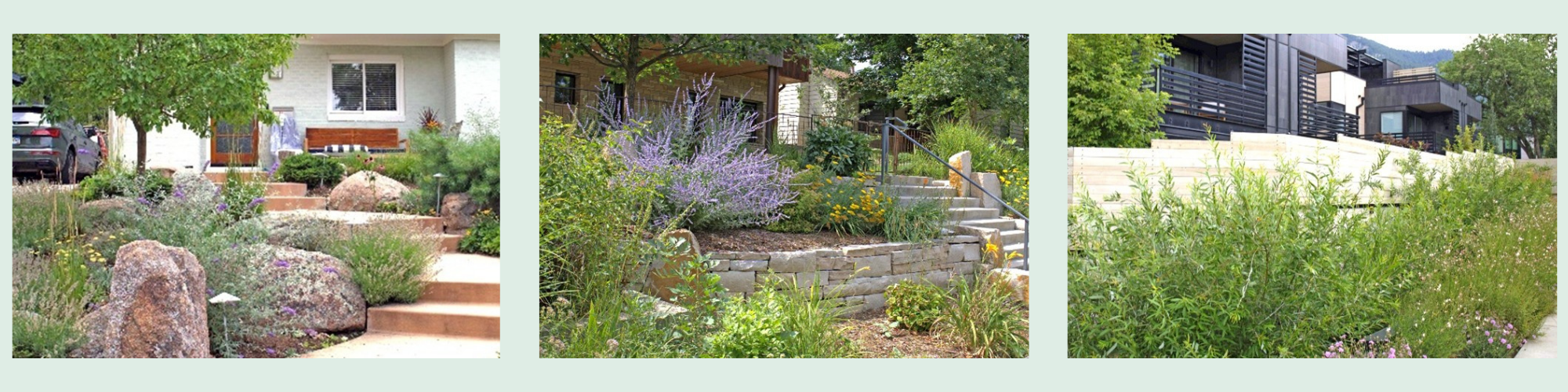
- A. All landscaping shall be designed and planted consistent with the following:
- Plants with the same water use requirements shall be grouped together on the same irrigation hydrozones and by sun exposure, soil type, and other climate considerations;
- The use of high-irrigation plantings shall be limited to high-use areas with high visibility or functional needs;
- Plants and grass with very low or low water use requirements shall be used to the extent practicable, and
- Soils shall be protected from compaction or improved to allow water absorption and proper drainage.
- B. Artificial turf, artificial plants, bare ground, weed-covered or infested surfaces, parking lots, or any landscaping inconsistent with this section are prohibited within landscape areas.
5.1 Water Use Rules
- A. In addition to the requirements in the Boulder Revised Code and other applicable city requirements regarding the use of city water, no person shall apply or allow the application of city water for the watering of any landscaping between the hours of 10 a.m. and 6 p.m., from May 1 through September 30, with the following exceptions:
- Watering through low-volume, drip, or sub-surface irrigation systems;
- Lots or parcels greater than five acres in size with pressure issues in the sprinkler system on such property, where such pressure issues have been demonstrated to the city manager’s satisfaction;
- Watering of new plant material for thirty (30) days following initial installation;
- Hand watering of trees, shrubs, or plants with a hose that includes a shut-off nozzle;
- Watering of areas for urban agriculture and food production;
- Watering of functional turf on sports fields; and
- Operating and attending to an irrigation system as needed for installation, repair, or reasonable maintenance.
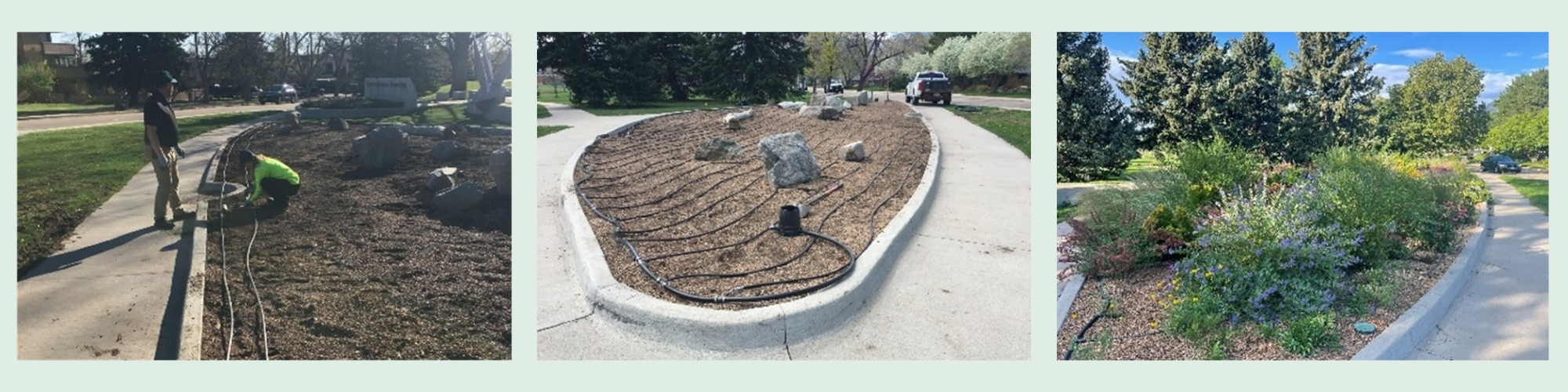
- A. The following standards apply to irrigation systems for required landscaped areas:
- All landscaped areas, including, but not limited to, trees in tree pits, raised planters, planting in the public right-of-way, and all landscaping required in this manual, shall be irrigated with a permanent, automatic irrigation system designed to provide efficient irrigation coverage with minimal overspray onto non-landscaped areas.
- The city manager may approve the use of temporary irrigation systems for a maximum of three years if all plant material is from very low or low water use plant categories.
- Low-volume, drip, or subsurface irrigation systems shall be used in the following conditions:
- In landscaped areas where any one dimension is less than six feet in width and surrounded by impervious surfaces, and
- In all non-turf grass areas.
- Trees shall be zoned separately from understory plantings or grass.
- A soil moisture sensing device or other irrigation management system are required for irrigation systems in turf areas.
- The landscape plan must indicate the nature, location, and specifications of the irrigation system which shall be used. The landscape plan must have sufficient detail to show that adequate irrigation will be provided to all required landscape areas and plant materials.
- The irrigation system shall be designed to correlate to the organization of plants into hydrozones with similar watering requirements.
- Irrigation systems shall be designed to maximize efficient water use and minimize the waste of water.
- A. The property owner shall maintain all required landscaping. The required maintenance includes:
- Mowing, irrigating, and weeding,
- Removing trash, weeds, and dead plants,
- Replacing dead plants included in landscaping plan,
- Replenishing materials like mulch, and
- Repairing structural features.
- B. The property owner shall maintain, repair, and replace all required landscaping, screening, and curbing depicted on any city approved landscape plan.
- C. The property owner shall remove noxious weeds in accordance with Section 6-2-3, “Growth or Accumulation of Weeds Prohibited,” B.R.C. 1981.
- D. Use of pesticides (all herbicides, insecticides, rodenticides, etc.) shall be consistent with Chapter 10, “Pesticide Use,” B.R.C. 1981, of Title 6, Health, Safety, and Sanitation.
Appendix A: WUI Requirements and Resources
Summary of Standards for WUI Lots or Parcels
Table A-1 is a summary of key requirements that apply to new construction of buildings and structures, including decks, or changes to site landscaping on WUI lots or parcels.
Improvements are required to comply with Chapter 10-8.5, “Wildland Code,” B.R.C. 1981, and Sections 9-9-12 “Landscaping and Screening,” and 9-9-15, “Fences and Walls,” B.R.C. 1981, including but not limited to these specific wildland standards, which are consolidated in this table for ease of reference and importance.
The summary is not exhaustive but is intended to provide the reader with some key guidance around landscaping and wildfire deterrence. Please consult the referenced standards, criteria, and procedures contained in this manual and the Boulder Revised Code for additional information.
Table A-1 – Summary of Wildland Code Requirements
| Summary of Wildland Code Requirements | Specific Wildland Code Section |
|---|---|
| Junipers | |
| Due to the high risk of flammability and risk to life and property, no species of Junipers (Juniperus spp) are allowed to be planted on or after August 1, 2025. Permits for new development or redevelopment require juniper removal. | Section 10-8.5; 603.2.6, Junipers |
| Noncombustible zone: A five-foot area around a building or other structure having no vegetation and no combustible material. | |
| To reduce the risk of wildfire ignition, a noncombustible zone prohibits vegetation and other noncombustible materials in the 0-foot to 5-foot zone around the perimeter of any footprint of any new buildings or structures, including decks and additions to existing structures. | Section 10-8.5; 603.2.4, Noncombustible zone |
| Defensible space: An area that has been modified and is maintained to reduce fire risk, intensity, and spreading by disconnecting fuel loads both vertically and horizontally. In this area, natural and manmade fuels are treated, removed, and reduced to slow the spread of wildfire and alter fire behavior. | |
| To reduce the risk of wildfire spread, within an area 5 feet to 30 feet from the perimeter of any footprint of any new buildings or structures, including decks and additions to existing structures, is required to have only low flammability plants as identified by the Boulder Approved Tree and Plant List for new plantings. In larger projects, existing vegetation not permitted by the Boulder Approved Tree and Plant list may require trimming per Section 10-8.5 to reduce wildfire risk. Existing junipers will also require removal in new development projects. | Section 10-8.5; 603.2.5, Fuels planted within defensible space |
| Fences and walls | |
| New fences and walls within 8 feet of any building or structure are required to be constructed of noncombustible materials per Section 503.2.1 | Section 10-8.5; 508, Fencing 503.2.1, Noncombustible material |
| Decks, unenclosed accessory buildings | |
| New decks or unenclosed accessory buildings are required to be constructed of ignition-resistant building materials etc. | Section 10-8.5; 503.2.4.4, Appendages and projections |
Wildland Landscape Guidelines
Also see the Wildland Landscape Guidelines for best practices and tips for planting on properties within the WUI to reduce wildfire risk.