

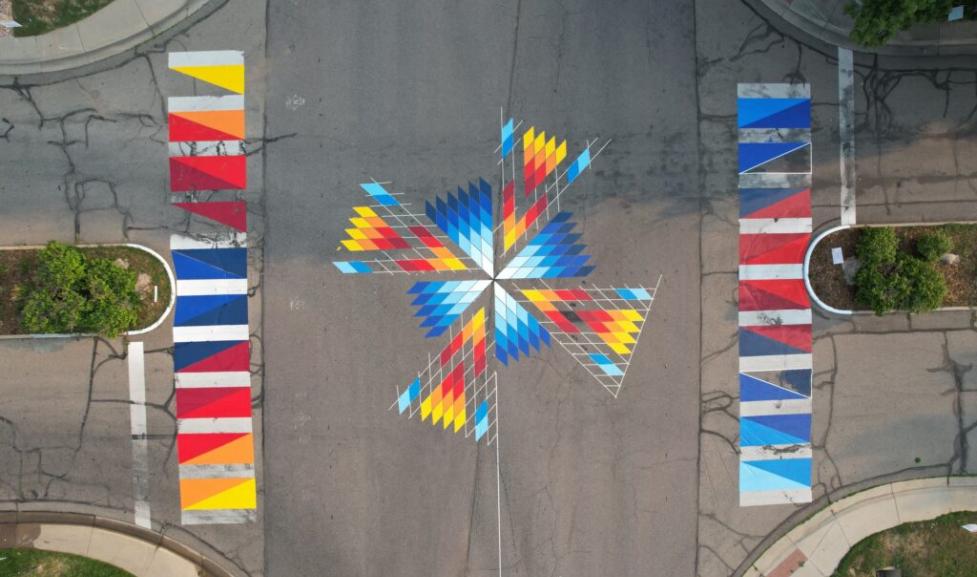
Neighborhoods interested in pursuing a Paint the Pavement project should begin by carefully reviewing the program requirements on this webpage. The webpage includes tips on what types of projects you should consider and instructions to apply for city approval to paint a mural in the public right-of-way.
Paint the Pavement is a city program that allows mural painting on public streets to encourage community building and public art as a means to transform roadway public space into neighborhood assets. The program was created in response to neighborhood interest and encouragement from City Council and the Transportation Advisory Board.
How to Paint the Pavement
Step 1: Choose a Location
Quiet residential streets are the best candidates for Paint the Pavement projects. Projects can be installed at low-volume intersections or at mid-block locations. After you apply, the City Traffic Engineer will review your proposed location for safety concerns and determine if it is a good candidate for a Paint the Pavement Project installation.
While installing the project, the street or intersection must be closed to ensure the safety of all participants. fashion to ensure the safety of all participants. The City Traffic Engineer will determine what type of street closure must be used based on traffic volumes and safety considerations. A Method for Handling Traffic (MHT) may be necessary to close the street. A MHT is an official detailed plan that outlines how traffic control devices (signs, barriers, cones, etc.) will be installed, managed, and removed to safely guide travelers through the project work zone. If a MHT is required, the applicant is responsible for obtaining it from a traffic control company. All costs related to the design and implementation of the closure are the responsibility of the applicant.
If a Method for Handling Traffic (MHT) is required, it must be developed and implemented under the supervision of a certified Traffic Control Supervisor (TCS) or certified Traffic Control Technician (TCT). The TCS or TCT will be responsible for delivering and installing barricades in the proper positions as depicted in the MHT at the beginning of the event, and removing them at the end of event and returning them to delivery location. Most barricade rental companies have a TCS or TCT on staff, who can provide an estimate for their services.
Paint the Pavement projects on high-volume streets or that are larger or more complex may require a Special Events Permit. After you apply, you will receive a message through the application portal with the requirements for the street closure or Special Events Permit.
Step 2: Create Your Design
Your project design can include community identity logos, but no advertising of any sort is allowed. Using text is discouraged and designs should not replicate or mimic traffic control devices (such as stop signs or crosswalks). Design approval is at the sole discretion of the city. If your design requires modifications to be approved, you will receive a message through the application portal after you apply.
Step 3: Plan Your Paint the Pavement Event
Paint the Pavement events are similar to neighborhood block parties – gatherings of residents in a neighborhood for the purposes of painting the street mural, building relationships, and fostering community. To help you plan your Paint the Pavement event, please see the information and requirements below.
Paint the Pavement events can include:
- the closing and barricading of a city street or intersection (required)
- the painting of the street mural
- the availability of refreshments
- activities within the blocked street area
- other activities that are legal and safe
Paint the Pavement events DO NOT include:
- loud music
- alcohol on public streets, sidewalks or other city property
- unknown or uninvited guests
- mandatory cover charges
- closure of more than one street or intersection
- any activities that could result in city code violations
- more than the designated number of participants
- any activity that violates the Paint the Pavement permit
- any illegal or unsafe activity or behavior as determined by the Police and Fire departments
Paint the Pavement events must be held between the hours of 8 am and 10 pm.
- Amplified music is only allowed between noon and 10 pm. If you plan to have live or amplified music, you must remain in compliance with section 5-9-3, B.R.C. Noise levels may not exceed 65 decibels at the edge of the event area. You are responsible for monitoring amplified sound noise levels throughout the event to ensure compliance. Events not in compliance may be subject to citations, fines, permit revocation, and/or future permit denials.
- No more than 50 people may attend. Special approval must be given by the city if the event is expected to generate more than 50 attendees at one time.
- Paint the Pavement events may not be held on major roads or areas where safety is a concern, as determined by the City Traffic Engineer.
- The applicant is responsible for obtaining the street closure devices and implementing the street closure plan, as determined by the City Traffic Engineer. If a Method for Handling Traffic (MHT) is required, the applicant is responsible for obtaining it from a traffic control company. All costs related to the design and implementation of the street closure plan are the responsibility of the applicant.
- Alcohol is not permitted on public property (in city streets, sidewalks, parks, etc.). Sale or provision of alcohol to the public is prohibited. Alcohol may be consumed on private property only as a closed or invite only event. All state and city alcohol laws apply during Paint the Pavement events.
- 10-foot by 10-foot tents are permitted during the Paint the Pavement event. The applicant must ensure that the tents are properly weighed down; 40-pound weights per tent leg are recommended.
- The Paint the Pavement applicant must be at least 18 years of age and a resident of the block to be closed.
Paint the Pavement Projects on high-volume streets or that are larger or more complex may require a Special Events Permit. After you apply, you will receive a message through the application portal with the requirements for the street closure or Special Events Permit.
Step 4: Apply for a Paint the Pavement Permit
- Carefully review the Paint the Pavement Project requirements on this webpage.
- Submit the online Paint the Pavement application 90 days before your proposed project event date. You will need the following materials to apply for a Paint the Pavement Permit:
- Written description and map of your proposed project location and which sections of the street you are proposing to close for the event.
- Written description and diagram showing your proposed project design. The diagram should include dimensions and orientation on the street.
- Proposed date, time, and event details for your Paint the Pavement event.
- Receive approval within 20 days of a complete application submittal from the Office of Arts and Culture and Transportation & Mobility Department for your proposed design. If your design requires modifications in order to be approved, you will receive a message through the application portal.
- Receive approval within 20 days of a complete application submittal from the Transportation & Mobility Department, Police Department, and Fire Department for your proposed project location and street closure. If your proposed project location requires modifications to be approved, you will receive a message through the application portal.
- The City Traffic Engineer will determine what type of street closure must be used based on traffic volumes and safety considerations. A Method for Handling Traffic (MHT) may be necessary to close the street. A MHT is an official, detailed plan that outlines how traffic control devices (signs, barriers, cones, etc.) will be installed, managed, and removed to safely guide travelers through the project work zone. If a MHT is required, the applicant is responsible for obtaining it from a traffic control company. The proposed MHT must be submitted through the application portal 60 days before the project event date. If the city requires changes to the MHT, you will receive a message through the application portal. The final MHT must be submitted through the application portal 30 days before the project event date. Paint the Pavement project events or street closures that are larger or more complex also may require a Special Events Permit. You will receive a message with the requirements for the street closure or Special Events Permit through the application portal.
Once your design, location, and street closure plan are approved, you will be provided a petition template through the application portal to use to petition neighbors at least 30 days before the project event date. You should submit the completed petition at least 14 days before the Paint the Pavement project event.
The petition must be circulated in the neighborhood to show support for the Paint the Pavement project event, the street closure, and the design of the street mural. The petition process serves to contact the residents/businesses on your block(s) and notify them of your plans for a Paint the Pavement event and street closure. This helps avoid misunderstandings and signifies to the city that the majority of neighbors endorse this event, and helps strengthen neighborhood relations. Should any conflicts arise about the proposed Paint the Pavement project event date, time, location, street closure, or street mural design, it is the responsibility of the applicant to work through the issue with your neighbor(s).
The Paint the Pavement Petition must have signatures from 100% of the property owners directly abutting the project and at least 60% of the property owners and/or residents on the project street frontage(s) within the “impact area” which is defined as one standard city block (or 400 feet) of the proposed project, or within the area to be closed for the painting event, whichever is greater. Each residence within the impact area will only receive one “vote” per address. Either a renter or property owner may sign the petition form on behalf of an address, but not both. Multi-family units require the approval of the property manager or homeowner association, or 60% of unit owners or tenants. For public properties, the site manager’s approval is adequate. The Traffic Engineer may modify the petition boundaries when considered appropriate.
- Complete the Paint the Pavement Installation Agreement. You will be notified when your Installation Agreement is ready for you to sign in the application portal.
- Obtain and display your Paint the Pavement permit and executed Installation Agreement at your event.
If you need to utilize your back-up event date (in case of bad weather or not completing painting on your original event date), you must send a message to the city through the application portal. If approved, the city will issue a new Paint the Pavement permit for you to use on your back-up date.
Step 5: Paint the Pavement
Before the Event
- Purchase your paint.
Paint must be low-toxicity and lead-free. The city recommends using water-based paints because they are easier to clean-up and generally have lower toxicity. The city also encourages applicants use an aggregate, either mixed into the paint, or applied as a coating afterwards, to increase traction and avoid the paint becoming a slip risk. Acceptable options include latex (waterborne) paints from Diamond Vogel or Colorado Paint (this is what the city uses for street application). Other lead-free exterior latex or enamel paints are acceptable.
During the Event
- Display your Paint the Pavement permit and executed Installation Agreement at your event.
If you need to utilize your back-up event date (in case of bad weather or not completing painting on your original event date), you must send a message to the city through the application portal. If approved, the city will issue a new Paint the Pavement permit for you to use on your back-up date. - Take at least two photos of the work-in-progress and the finished project.
- If you have any problems during the Paint the Pavement event, please call the police at the non-emergency number 303-441-4444. For an emergency, call 911.
After the Event
- The applicant is responsible for clean-up within 12 hours after the event. It is important that no paint or clean-up water be disposed of in storm drains as they drain directly into our creeks. Clean-up should be done in a sink which drains into the sewer system.
- Send the Office of Arts and Culture photos within two weeks of the event. Submit at least two photographs of the finished project. Photos of work-in-progress and a brief written summary of the project with advice to others considering a project would also be appreciated. We may post these on the city website. Please send the photos and summary to the Office of Arts and Culture (publicart@bouldercolorado.gov).
Touching Up Your Mural
- Existing Paint the Pavement projects suggest that the artwork may need to be retouched every 1-3 years. Wear and tear, street repair, street maintenance, street reconstruction, repair of existing utility facilities or installation of new utility facilities in the right-of-way may affect the project.
- If an applicant wishes to touch-up an existing project, they will be responsible for all costs and should submit a new Paint the Pavement application. There is a section in the application to indicate the application is to refresh or repair an existing project.
Paint the Pavement Image Gallery

1 of 3

2 of 3

3 of 3


