

The Pawnee Nation of Oklahoma is headquartered in the town of Pawnee in north central Oklahoma. The Pawnee were removed from their homelands along the North Platte River in 1875, when the federal government moved them to Oklahoma (Pawnee Nation, 2020). This new environment presented incredible challenges to the Pawnee, as they were forced to adapt to an entirely new way of life and negotiate their existence with the federal government (Royce Blaine, 1990; 1997). Even before their removal, the Pawnee people faced hardships in Nebraska due to the presence of missionaries. Their traditional way of life and cultural practices were disrupted as missionaries attempted to convert the Pawnee to Christianity. Many Pawnee were introduced to European-style agriculture and settlement practices, which conflicted with their traditional nomadic or semi-nomadic lifestyle. Additionally, the arrival of settlers and traders, driven by westward expansion, led to the disruption of the Pawnee's land and resources (Dunbar, 2010; Irving 2001). Prior to colonization, a rich Pawnee culture of sophisticated economic practices, hunting techniques, and communal activities (like the Chawi Winter Hunt) existed in the Great Plains region (Roper, 1991).
The Pawnee Nation
Contributors
- Martha Only A Chief, NAGPRA Coordinator for the Pawnee Tribe of Oklahoma
- J. Matt Reed, Tribal Historic Preservation Officer for the Pawnee Tribe of Oklahoma
Pawnee in the Boulder Area
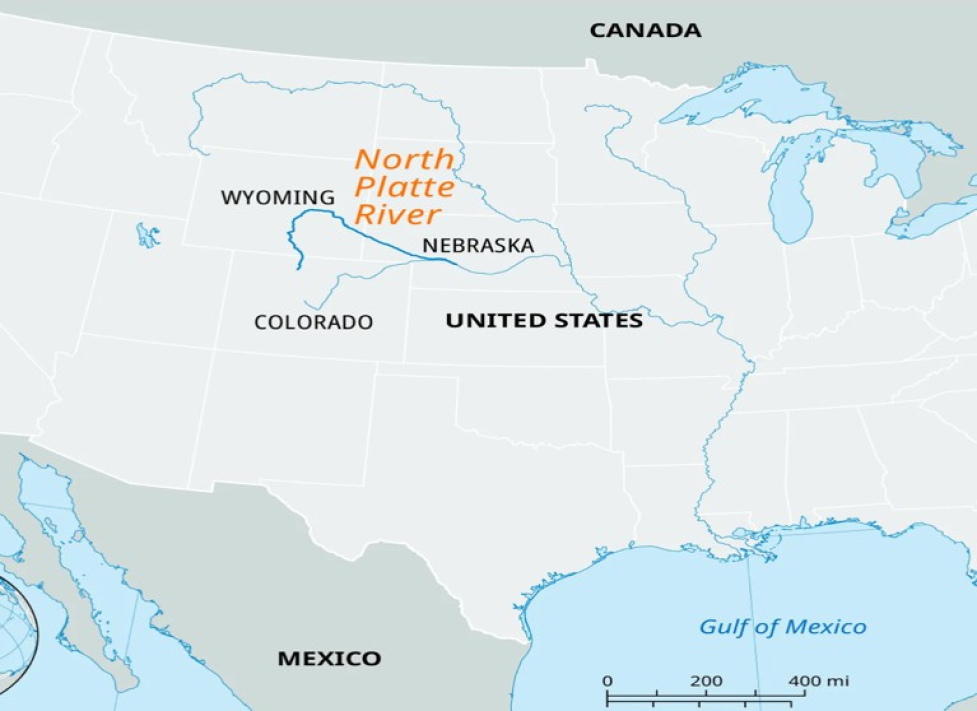
The North Platte River (Encyclopædia Britannica)
We live by water, and I think that's why we traveled over here because we always followed water. And that's part of our history. I mean, even when we lived in Nebraska, it was always by the Platte River, you know. We've always lived by the water. I think that's just because it's a resource.
-Martha Only A Chief
The North Platte’s headwaters are in Coalmont, Colorado; just 100 miles northwest of Boulder. The Front Range’s abundant resources made it an attractive area for Pawnee people in the precolonial and early historical periods. The Pawnee created trails to the area primarily to hunt buffalo, who were being slaughtered for their hides by non-native settlers.
The Pawnee oral history stretches back hundreds, even thousands, of years, serving as a vital source of continuity for the community. It preserves not only the memory of significant sites but also ways of life and intricate cosmology, which blends spirituality, astronomy, and their cultural practices (Chamberlin, 1982). Like their cosmology, Pawnee social organization is intricate and thousands of years old. The Pawnee people consist of four bands, Pitahawirata, Kitkehahki, Chawi, and Ckiri. The Ckiri band has their own dialect of Pawnee, and the three other bands all speak a version of Pawnee called the South Band dialect (Only A Chief, 2025). Within these bands, Pawnee individuals held distinct roles, and one unique way they identify themselves among other Native peoples is through their distinct pottery styles.
They would come and they would camp. And then they – the men – would go out and hunt while the women would start setting up the tipi and preparing for when they come back. And then when they come back, then they would get the meat and skin it and all that. […] It wouldn't be everybody. It'd be just the ones that normally went hunted. And they'd probably bring the younger ones to, you know, show them what they need to do. […] So, they would stay in one place. They wouldn't move around and go hunt and go to different places. That's why you find scrapers, and there’s been pottery found. Different Tribes have different ways of identifying themselves and ours is cord marking. I guess the best way to say is, like a popsicle stick, and then get a cord and just wrap it around. When they make that pottery, they take that thing [stick] and just go all the way around. That's why they call it ‘cord marking’ on our pottery. Ours would have handles on them sometimes. But the other Tribes are different.
-Martha Only A Chief
Pawnee Perspectives on Animals
It wasn’t just the Boulder Valley that held significance for the Pawnee, there are important spiritual and cultural sites in various parts of the state. Garden of the Gods in Colorado Springs was (and still is) a destination for the Pawnee and this impacted the expanse of their cultural landscape. In Pawnee history, the Garden of the Gods is the place buffalo would go to give birth, ensuring the continuity of this important subsistence animal. The importance of the buffalo is reflected in the petroglyphs of the Pawnee homelands, where bison are a common motif (Loendorf, 2008). The presence of buffalo historically drew Pawnee people to the Boulder area and beyond. But as non-native people moved in and started hunting buffalo for sport and trophy hunting, the Indigenous people who respected them as a valuable resource were left with a dwindling population of the animal that once provided so much.
That’s why we came over this way from Nebraska, just due to food resources. Because ours were getting eliminated by whomever shooting just for fun and not for use. We used everything from the bison, the buffalo. They [Pawnee people] used the hide. I mean they used the horn, made spoons out of the horns. I think we used as much as we could. […] all parts of the body. We didn't throw anything away. We had dogs because they were like horses at times, you know. So, that's probably what they fed them, whatever was left over [from the buffalo]. And our utensils, they made spoons out of the bison horns and bags out of their guts or their insides. That’s what it provided to us.
-Martha Only A Chief
Dogs were another important animal, serving a different role than the buffalo. The Pawnee people have a long history with these animals, often using them alongside or in place of horses. Ms. Only A Chief explained that dogs were considered "like gold" because of their ability to carry and drag materials over long distances. While both dogs and buffalo had practical purposes, they also held spiritual significance. Many animals were culturally and spiritually meaningful to the Pawnee, such as the eagle, which Ms. Only A Chief described as "a blessing."
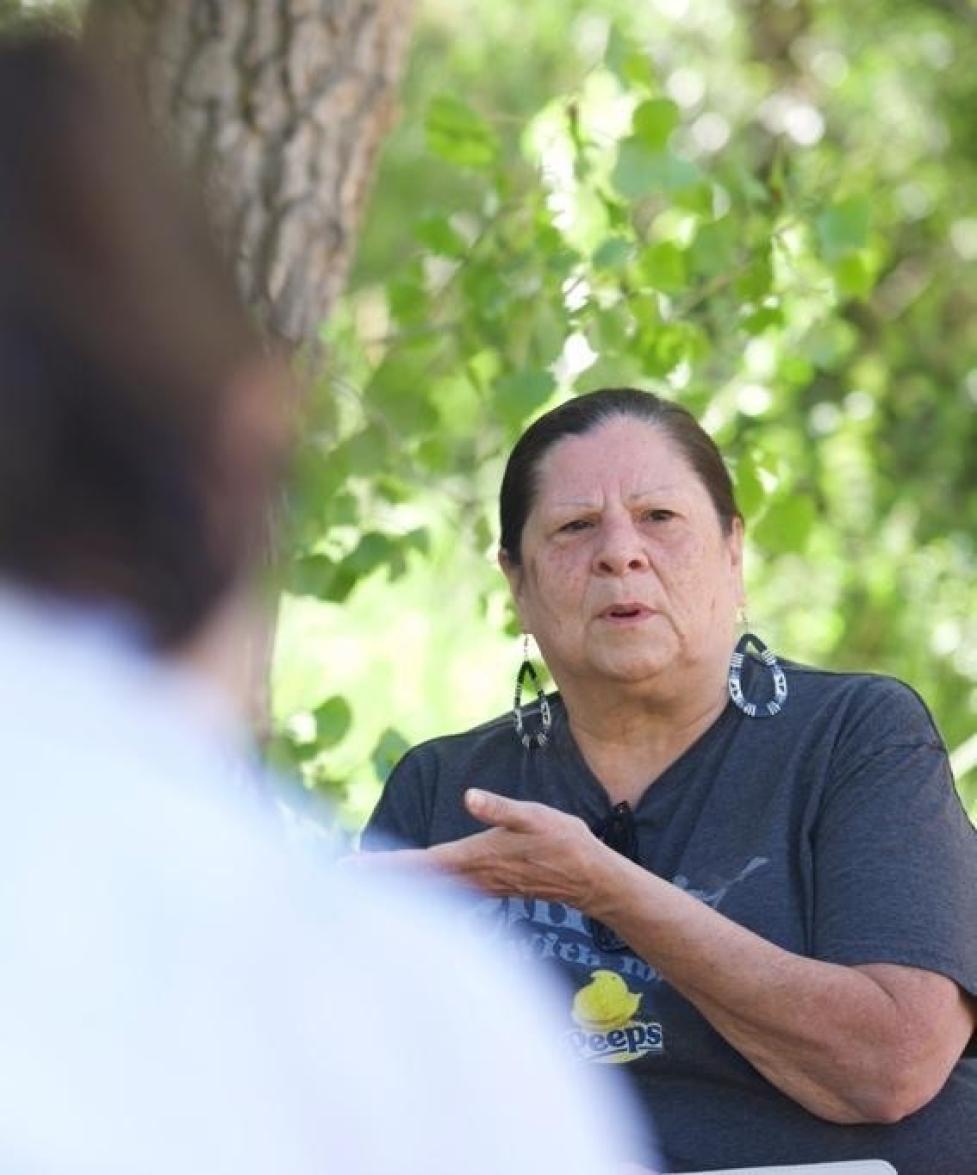
Ms. Only A Chief
Pawnee Perspectives on Water
Water is a resource with multi-faceted meaning for the Pawnee people. As expressed, “Water is, water is life. You can't live without it” (Only A Chief, 2024). The waters of the North Platte River served many vital purposes when the Pawnee people lived in their homelands. As Ms. Only A Chief explains,
You live by water because you have that access to water your crops, feed your family and you don't have that far to carry water. Because you have to have water to survive. So that's why we've always lived by water.
-Martha Only A Chief
In addition to its practical value for crops, people, and animals, water holds deep spiritual significance that has been passed down through generations. Water can help a person who needs healing, or to calm the soul and soothe the mind.
What I was told: if I’m having a hard time or things aren't going right; go to the water and watch the water because it'll calm your soul. It'll calm your mind. So sometimes I'll go to this lake and then I'll just go out there and sit there and then I'll just start talking […] And then after that, I just feel better.
-Martha Only A Chief
Given its many essential roles, water remains a cornerstone of Pawnee life. The loss of access to clean river water when the Pawnee were relocated to Oklahoma underscores its importance. The water flowing through the Boulder Valley should be treasured as the gift it truly is. The value of water is ever increasing as the climate changes, building projects progress, and the population increases. This is a pattern the Pawnee witnessed historically and are observing today.
Pawnee, where I live, we've been having rain almost constantly for two weeks and that's unusual. It is crazy how this climate changes. [...] You got running water coming from there [a creek in the distance]. I guess the only thing is just the building. How much more do you need to build? How much more are you gonna take away, you know? […] Where I live, we don't have running water like that. We just have a lake. And as I keep saying, you're blessed to have something like this. Because we're all fighting for water where we live. It's not really drinkable. We always have a ‘boiling water order’ throughout the city. The people that use the water. So, you're lucky and it's awesome to see that.
-Martha Only A Chief
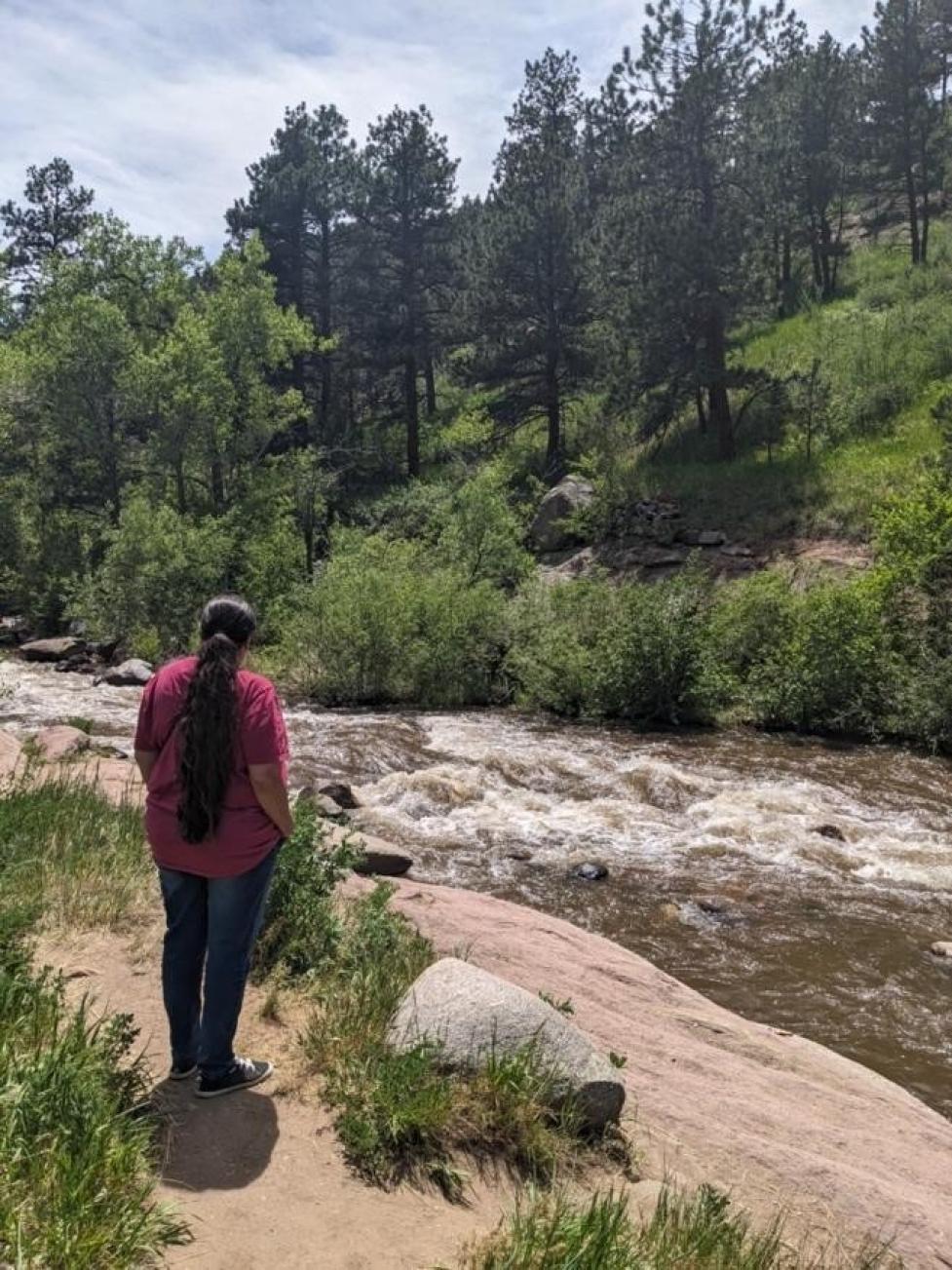
Ms. Only A Chief observing a river
Pawnee Perspectives on Plants
Being in the Boulder area serves as a reminder of Pawnee people that once existed on the land, and can inspire a sense of connection and continuity for the Pawnee today. Speaking about the area, Ms. Only A Chief reflected on a deep sense of connection to the land, ancestors, and spiritual practices. She spoke about the significance of knowing where their ancestors traveled, how they honored the land, and the rituals they performed, such as praying and offering tobacco before taking anything from nature. She shares the special bond that certain places hold, like the Garden of the Gods, where the act of gathering cedar was intertwined with prayer and gratitude. It’s a reflection on the peacefulness and reverence of tradition, highlighting the importance of emotional and spiritual connections to both people and places across generations.
To us, anything traditional is anything that you can use from the earth for any reason – whether it's medicine, whatever. Sage or flat cedar, that's what we pray with or just cedar but, that's culture to us. Because we use that for specific reasons. It's not just to tear things down or to take everything and not leave something.
-Martha Only A Chief
The following is a list of plants that are found in the Boulder area and their names in Pawnee.
| Pawnee Name | Scientific Name | English Name |
|---|---|---|
| usâku | Negundo aceroides ssp. interius | boxelder |
| cakîra (south band) cakirâkahcu' (Ckiri) | Yucca glauca | yucca/ Spanish bayonet |
| lup'-it or lup'-it-kur-i-wi | Rhus aromatica ssp. trilobata | three-leaved sumac/ skunkbrush |
| lup'-it or lup'-it-kur-i-wi | Rhus glabra | smooth sumac |
| kahcahîtu' | Ligusticum porteri | osha / lovage |
| kit-au'-i-u | Achillea lanulosa | yarrow |
| kit-au'-i-u | Ambrosia psilostachya var. coronopifolia | western ragweed |
| kit-au'-i-u | Ambrosia trifida | giant ragweed |
| kêwuhki | Artemisia frigida | fringed sage/ silver sage |
| ka-wau'-it | Artemisia ludoviciana | prairie sage/ Louisiana sagewort |
| kirikitahkatâru' | Helianthus annuus | common sunflower |
| kirikitahkatâru' | Helianthus pumilis | Nuttall's sunflower |
| ksapitâhaku (Ckiri) ksapitâhâku (south bands) | Ratibida columnifera | prairie coneflower |
| pîrahatus or pirahatuskatus | Opuntia macrorhiza | twistspine prickly-pear cactus |
| kipahki (Ckiri) čahriksikskîsu' (south bands) | Chenopodium album | goosefoot |
| tawačâku | Juniperus communis ssp. alpina | common/ spreading juniper |
| tawačâku | Sabina scopulorum | Rocky Mountain juniper |
| sistâtu' or sistat | Scirpus pallidus | cloaked bulrush |
| rakasis | Arctostaphylos uva-ursi | kinnikinnick / bearberry |
| ke-ha-pir-i-us | Dalea purpurea | purple prairie clover |
| may have been seen as any other rush sistâtu', sistat; | Juncus arcticus ssp. ater | arctic/ baltic rush |
| may have been seen as any other rush sistâtu', sistat; | Juncus interior | interior rush |
| cusâhtu' | Monarda fistulosa var. menthifolia | wild bergamot/ bee balm |
| kai-it-u | Oxalis stricta | yellow oxalis/ woodsorrel |
| pîcuc | Hesperostipa comata | needle-and-thread |
| pakuckucu' (Ckiri) Pakuckucu'(south bands) | Schizachyrium scoparium | little bluestem |
| kacpîrakari' | Rumex crispus | curly dock |
| riwaharikasis (Ckiri-dwarf plum with small fruit) Riwaharit (south bands-plum fruit) riwahariktâtu' (south bands-plum bush) riwaharikiripirus (south band- small plum variant) | Prunus americana | wild plum |
| pahâtu | Rosa sayi (acicularis) | prickly rose |
| aparûpahat or aparu | Rubus idaeus subsp. melanolasius | red raspberry |
| may have been seen as just a cottonwood; pasakîtu' | Populus angustifolia | narrow-leaved cottonwood |
| Ruk-a-ra-kus-pit-u; Pus-ukr; Us-a-hak-ta-kar-u; Pus-uk-uts | Populus deltoides ssp. monilifera | plains cottonwood |
| could have been seen as another type of cottonwood | Populus tremuloides | aspen |
| Kitapatu; Depending on when introduced, could have been seen as another type of willow | Salix alba var. vitellina | golden osier |
| Kit-up-a-la-rus | Salix amygdaloides | peach-leaf willow |
| Kit-up-a-la-rus | Salix bebbiana | Bebb willow |
| Kit-up-a-la-rus | Salix exigua | sandbar willow |
| Kiriktacarus | Typha angustifolia | narrow-leaved cattail |
Pawnee Perspectives on Traditions
Appreciating what one has is an important lesson from the Pawnee, who have nearly lost and revitalized several of their cultural traditions. The 1883 Code of Indian Offences outlawed Indigenous spiritual and religious practices like dances, gift-giving, and medicine men (Price, 1883). This law was in place for 95 years until 1978, when the American Indian Religious Freedom Act was signed by President Carter (American Indian Religious Freedom, 1978). Any Native person over the age of 50 can remember a time when they weren’t allowed to engage in their cultural and religious practices, and knows that their parents, grandparents, and even greatgrandparents couldn’t do so either. The resilience of traditional practices demonstrates the resilience Native people everywhere. These dances and traditions are more meaningful than many non-native people assume; for example, the Ghostdance, a form of traditional game involving hidden objects and teams, was used as a medium for expressing cultural values, social bonds, and religious beliefs tied to the Ghost Dance (Lesser, 1978). Ms. Only A Chief talked about how the Nation has started holding spring and fall dances, where they feed their people and perform traditional dances. She expressed her love for dancing, as it connects her to the heartbeat of the drum. While acknowledging that their efforts to revive their culture might not have exactly replicated what their ancestors did, she emphasized the importance of preserving it. She highlighted that it was their responsibility to keep the culture alive.
There's a difference between ceremony and spiritual things. To us, ceremony- the only ceremony that we had that's been brought down from Nebraska is when we put our people away [i.e. funeral]. That's the only ceremony that's carried on and still carried on. Same way, same thing. […] We mourn for four days. We feed the people, feed the family. And then we give away whatever people bring us. […] The thing about Pawnee people is we take care of each other. […] We've lost most of our dances due to being told we couldn’t do our dances when we went to Oklahoma. So, the people that used to do dances, they didn't continue, just to keep the family from getting in trouble. So, we've lost ceremonial dances.
-Martha Only A Chief
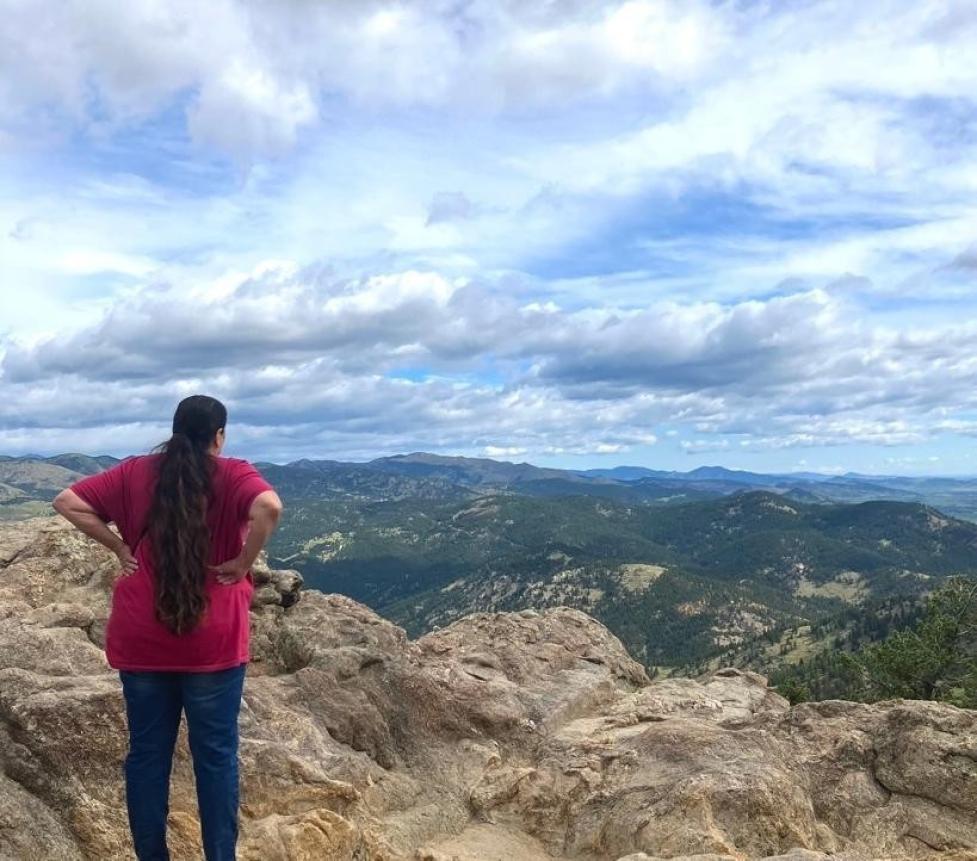
Ms. Only A Chief observes a Boulder viewscape
Pawnee Perspectives on Protection
Protecting the natural spaces in the Boulder area is crucial for preserving the region’s rich biodiversity, maintaining ecological balance, and supporting the health and well-being of its residents and associated peoples. The area's unique landscapes offer vital habitats for diverse wildlife, while also serving as essential areas for connection to nature. These natural spaces help regulate the local climate, improve air and water quality, and provide flood protection. Additionally, they play a significant role in the cultural and spiritual lives of many, offering opportunities for reflection, healing, and outdoor activities that foster a sense of community. By safeguarding these precious landscapes, Boulder ensures that future generations will continue to experience the beauty and benefits of its natural environment, while also contributing to global efforts to preserve natural ecosystems and mitigate climate change. Caring for the environment is a universal concept that we can all connect to. It is vital to engage staff, volunteers, and the public in this goal so everyone can work together to preserve the natural spaces that mean so much to us all.
One has to have love for the land to protect that land. They have to have that compassion and appreciate Mother Earth.
-Martha Only A Chief
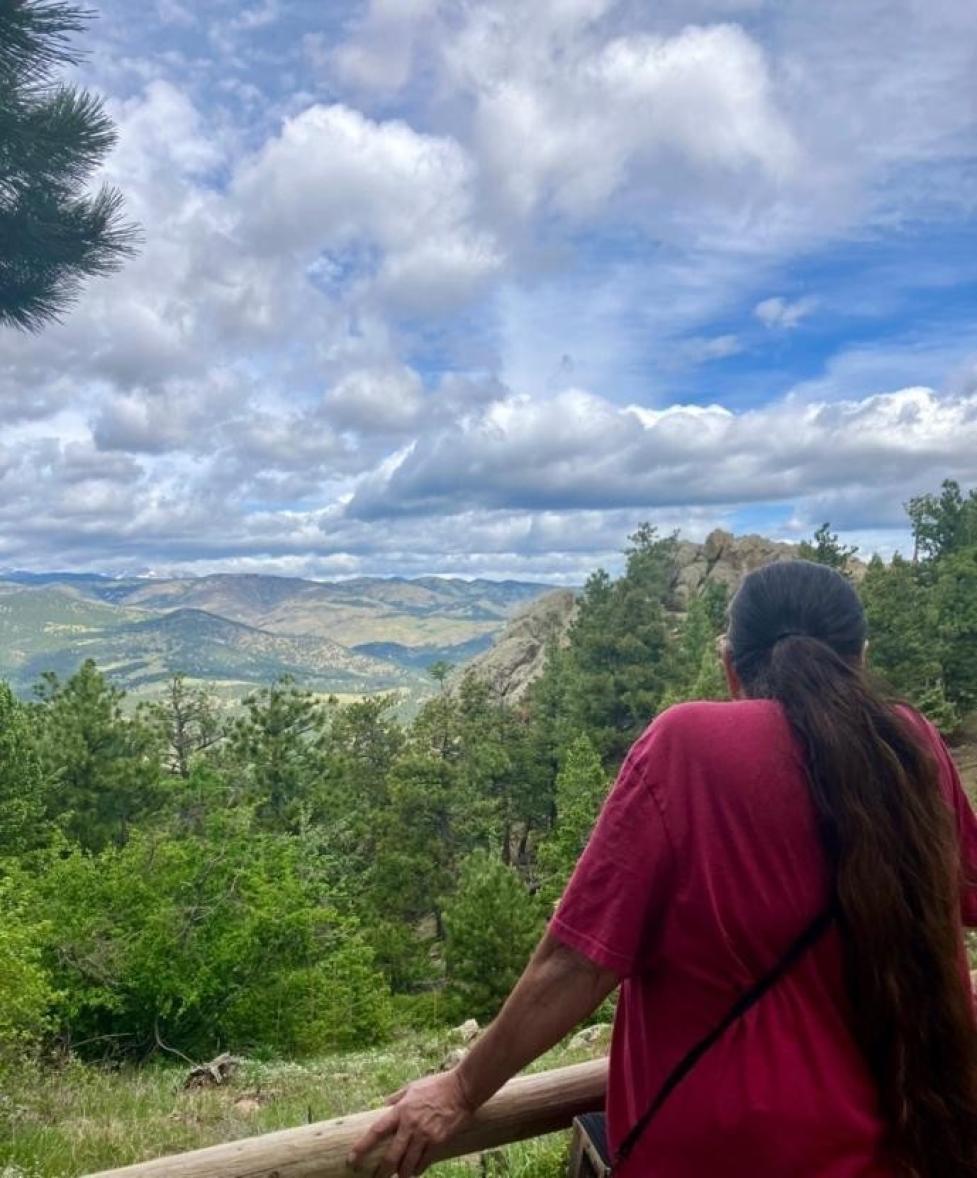
Ms. Only A Chief on a Boulder OSMP trail
Not only can the natural places around Boulder be protected for residents and visitors, but also for future generations of Native children who need a connection to their culture and homelands. Ms. Only A Chief reflected on how many of her people, especially the youth, don’t have the opportunity to experience important places or learn about their history. She hopes that by exposing younger generations to these locations, it will inspire them to pursue education and connect with their heritage. Ms. Only A Chief emphasizes the importance of preserving these experiences so that future generations can witness and feel a connection to their ancestors.
[The] big thing right there, is to keep it going so later our people can come over here, our youth, and witness what I've witnessed. And it's different seeing it and hearing about it, but actually being here, it opens your mind, your heart to know that your relatives have been here.
-Martha Only A Chief
An often-overlooked element of protecting a place is protecting the stories and knowledge that comes with it. These narratives should only be provided by those who they concern. “Now more than ever, we want our stories to be told” (Only A Chief, 2024). Throughout history, the stories of Indigenous people in the United States have been told by non-native people. This third-party knowledge has perpetuated incorrect information and created false sources. As the Pawnee Nation continues its partnership with the City of Boulder, the rich history, culture, and stories from the Boulder area will continue to be uncovered and enjoyed.
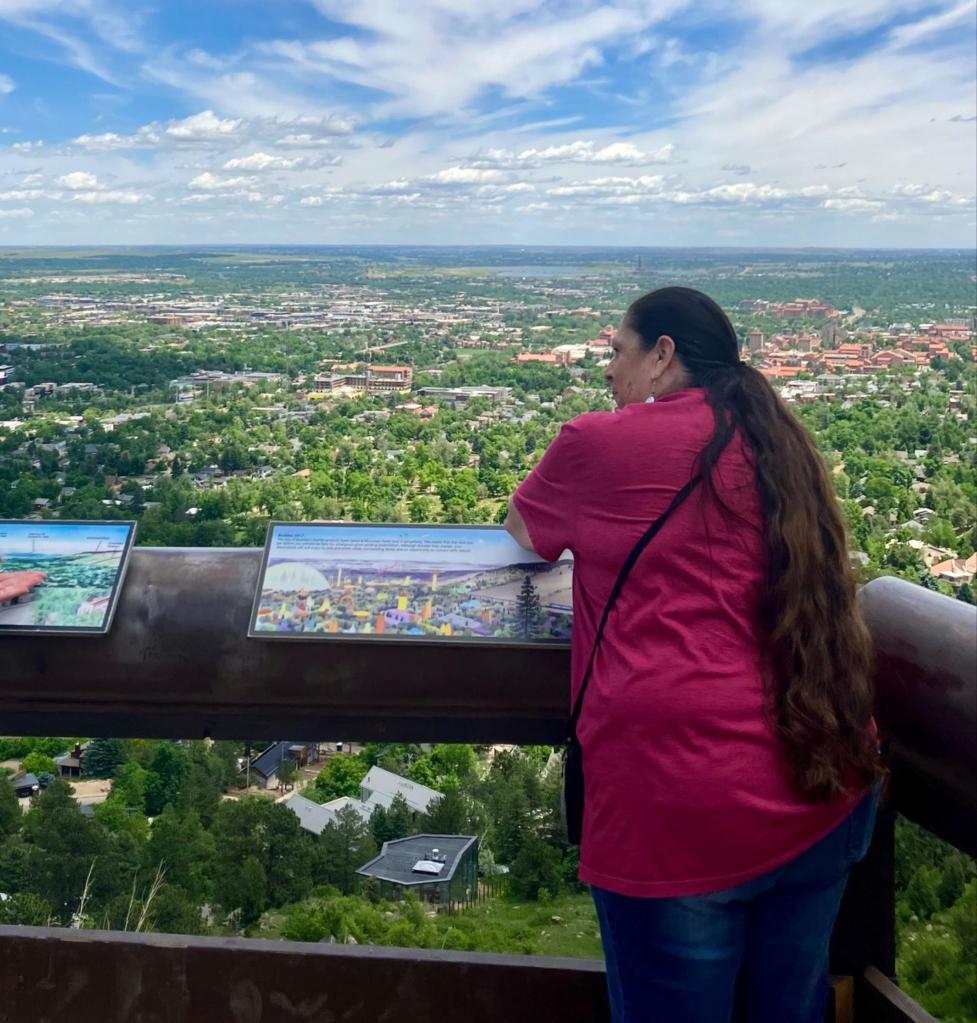
Ms. Only A Chief observing the City of Boulder from a lookout area
Bibliography
American Indian Religious Freedom Act. 1978. Public Law 95–341, August 11, 1978. 92 Stat. 469; 42 U.S.C. § 1996 et seq.
Beck, Margaret. 2020. “Pawnee Vessel Function and Ceramic Persistence: Reconstructed Vessels from the Burkett, Barcal, Linwood, Bellwood, and Horse Creek Sites.” Plains Anthropologist 65 (255).
Blythe, Jeffrey W. 2008a. Ethnohistoric Context Native American Consultation (Phase II), Cheyenne Mountain Air Force Station, Colorado. Milwaukee: TN & Associates, Inc.
Blythe, Jeffrey W. 2008b. Our Footprints Are There: Report of Native American Consultation to Identify Traditional Cultural Properties and Sacred Sites on Lands Administered by Fort Carson, Colorado. Prepared for Fort Carson. Loveland, TX: Gene Stout and Associates.
Campbell, Gregory R. 2007. An Ethnological and Ethnohistorical Assessment of Ethnobotanical and Cultural Resources at the Sand Creek National Historic Site and Bent’s Old Fort National Historic Site. Vols. 1–2. Missoula: University of Montana.
Chamberlin, Von Del. 1982. When Stars Came Down to Earth: Cosmology of the Skidi Pawnee Indians of North America. Los Altos, CA: Ballena Press.
Cunningham Fletcher, Alice. 1904. The Hako: A Pawnee Ceremony. Washington, DC: Government Printing Office.
Encyclopædia Britannica. 2025. “North Platte River.” Accessed February 5, 2025. https://www.britannica.com/place/North-Platte-River.
Frémont, John C. 1850. The Exploring Expedition of the Rocky Mountains, Oregon and California: To Which Is Added a Description of the Physical Geography of California, with Recent Notices of the Gold Region from the Latest and Most Authentic Sources. Buffalo, NY: Geo. H. Derby and Co.
Google Earth. n.d. “Distance between Coalmont, Colorado, and Boulder, Colorado.” Accessed February 5, 2025. https://earth.google.com/.
Grover, Carlton Shield Chief. 2022. Western Pawneeland: Oral Traditions, Archaeology, and Euro-American Accounts of Pawnees in the Front Range. Lecture published by the Crow Canyon Archaeological Center.
Grange Jr., Roger T. 1997. “The Pawnee and the Impact of Euro-American Cultures: Three Centuries of Contact and Change.” Revista de Arqueologia Americana 12.
Gunnerson, James H., and Dolores A. Gunnerson. 1988. Ethnohistory of the High Plains. Cultural Resource Series no. 26. Denver, CO: Bureau of Land Management, Colorado State Office.
Hudson, LuAnn. 1993. “Protohistoric Pawnee Lithic Economy.” Plains Anthropologist 38 (146).
Irving, John Treat. 2001. Indian Sketches Taken during an Expedition to the Pawnee Tribe in 1833. Santa Fe, NM: The Narrative Press.
Kelley, Shawn, Sean O’Meara, Damon Hill, and Karen Koestner. 2017. USAFA Ethnographic and Ethnobotanical Survey. Vols. 1–3. Prepared for the United States Air Force Academy and the United States Army Corps of Engineers, Philadelphia District. Albuquerque, NM: Parametrix.
Kelley, Shawn, Sean O’Meara, Damon Hill, and Marilyn Martorano. 2019. Traditional Use Study for Great Sand Dunes National Park and Preserve. Albuquerque, NM: Parametrix.
Kinbacher, Kurt E. 2012. “Indians and Empires: Cultural Change among the Omaha and Pawnee, from Contact to 1808.” Great Plains Quarterly 32 (3).
Lensink, Stephen C., Joseph A. Tiffany, and Shirley J. Schermer. 2020. Household Economy at Wall Ridge: A Fourteenth-Century Central Plains Farmstead in the Missouri Valley. Salt Lake City: University of Utah Press.
Lesser, Alexander. 1978. The Pawnee Ghost Dance Handgame. Lincoln: University of Nebraska Press. Loendorf, Lawrence L. 2008. Thunder and Herds: Rock Art of the High Plains. New York: Routledge. Murie, James. 1981a. Ceremonies of the Pawnee: The Skiri. Smithsonian Contributions to Anthropology 27.
Murie, James. 1981b. Ceremonies of the Pawnee: The South Bands. Smithsonian Contributions to Anthropology 27.
O’Meara, Sean. 2022. Indigenous Connections: Native American Ethnographic Study of Golden, Colorado, and the Clear Creek Valley. Prepared for the City of Golden and the Golden History Museum and Park. Tucson, AZ: Anthropological Research.
Parks, Douglas R. 1976. A Grammar of Pawnee. New York: Garland.
Parks, Douglas R., and Lula Nora Pratt. 2008. A Dictionary of Skiri Pawnee. Lincoln: University of Nebraska Press.
Parks, Douglas R., and Waldo R. Wedel. 1985. “Pawnee Geography: Historical and Sacred.” Great Plains Quarterly 5 (3).
Roper, Donna C. 1991. “John Dunbar’s Journal of the 1834–35 Chawi Winter Hunt and Its Implications for Pawnee Archaeology.” Plains Anthropologist 36 (136).
Roper, Donna C. 1994. “Documentary Evidence of Changes in Protohistoric and Early Historic Pawnee Hunting Practices.” Plains Anthropologist 37 (141): 353–66.
Royce-Blaine, Martha. 1990. Pawnee Passage: 1870–1875. Norman: University of Oklahoma Press. Royce-Blaine, Martha. 1997. Some Things Are Not Forgotten: A Pawnee Family Remembers. Norman: University of Oklahoma Press.
Steinke, Christopher. 2012. “Leading the ‘Father’: The Pawnee Homeland, Coureurs de Bois, and the Villasur Expedition of 1720.” Great Plains Quarterly 32 (1).
Stoffle, Richard W., Henry F. Dobyns, Michael J. Evans, and Omer C. Stewart. 1984. Toyavita Piavʉhʉrʉ Koroin: Ethnohistory and Native American Religious Concerns for the Fort Carson–Piñon Canyon Maneuver Area. Kenosha, WI: University of Wisconsin–Parkside.
Weltfish, Gene. 1936. “The Vision Story of Fox-Boy: A South Band Pawnee Text.” International Journal of American Linguistics 9.
Weltfish, Gene. 1977. The Lost Universe: Pawnee Life and Culture. Lincoln: University of Nebraska Press.
White, Richard. 1982. “The Cultural Landscape of the Pawnees.” Great Plains Quarterly 2 (1). Wilhelm, Duke Paul of Württemberg. 1973. Travels in North America, 1822–1824. Norman: University of Oklahoma Press.
Ethnographic Education Report Navigation
Explore the other reports linked below.
Cheyenne and Arapaho
The City of Boulder Ethnographic Education Report: Cheyenne and Arapaho
Comanche Nation
The City of Boulder Ethnographic Education Report: Comanche Nation
Lakota
The City of Boulder Ethnographic Education Report: Lakota: The Oglala Sioux Tribe and The Rosebud Sioux Tribe
Ute Mountain Ute Tribe
The City of Boulder Ethnographic Education Report: Ute Mountain Ute Tribe