The Ute Mountain Ute Tribe

Contributors

  • Terry Knight, Ute Mountain Ute THPO
  • A Ute Mountain Ute Tribal Elder

Presence and Movement

The Ute people's connection to the Boulder Valley is rooted in centuries of seasonal movement and cultural presence, long before European or American settlement (see Appendix 1 and 2 for maps of traditional Ute territories). The front range particularly was one of the migration areas for the Moache band. Mr. Knight emphasized the importance of historical recognition, stating, “the Ute people have been here for at least a minimum of 13,000, maybe 18, 20,000 years… So, we say, we were here forever.” As part of a broader seasonal round, Ute families moved through the region to hunt game, gather medicinal and edible plants, and engage in ceremonies tied to specific landscapes. Plants such as chokecherries and wild onion were staples, and oral histories continue to recount how families would camp together and pass down knowledge to younger generations. These were not only acts of sustenance but expressions of cultural continuity and reverence for the land. Brandi Denison (2017) describes this as “Ute land religion”—a relational worldview where land is sacred, reciprocal, and central to identity.

“(The Utes would be) coming back from the lowlands where there were foothills, getting ready, coming off the mountain, coming down into the lower elevation for the winter, and coming from lower elevation going into the mountains in the summertime... We were always mobile, going here and there. Nobody could say we can’t go. It wasn’t written; it was understood.”
-Mr. Terry Knight
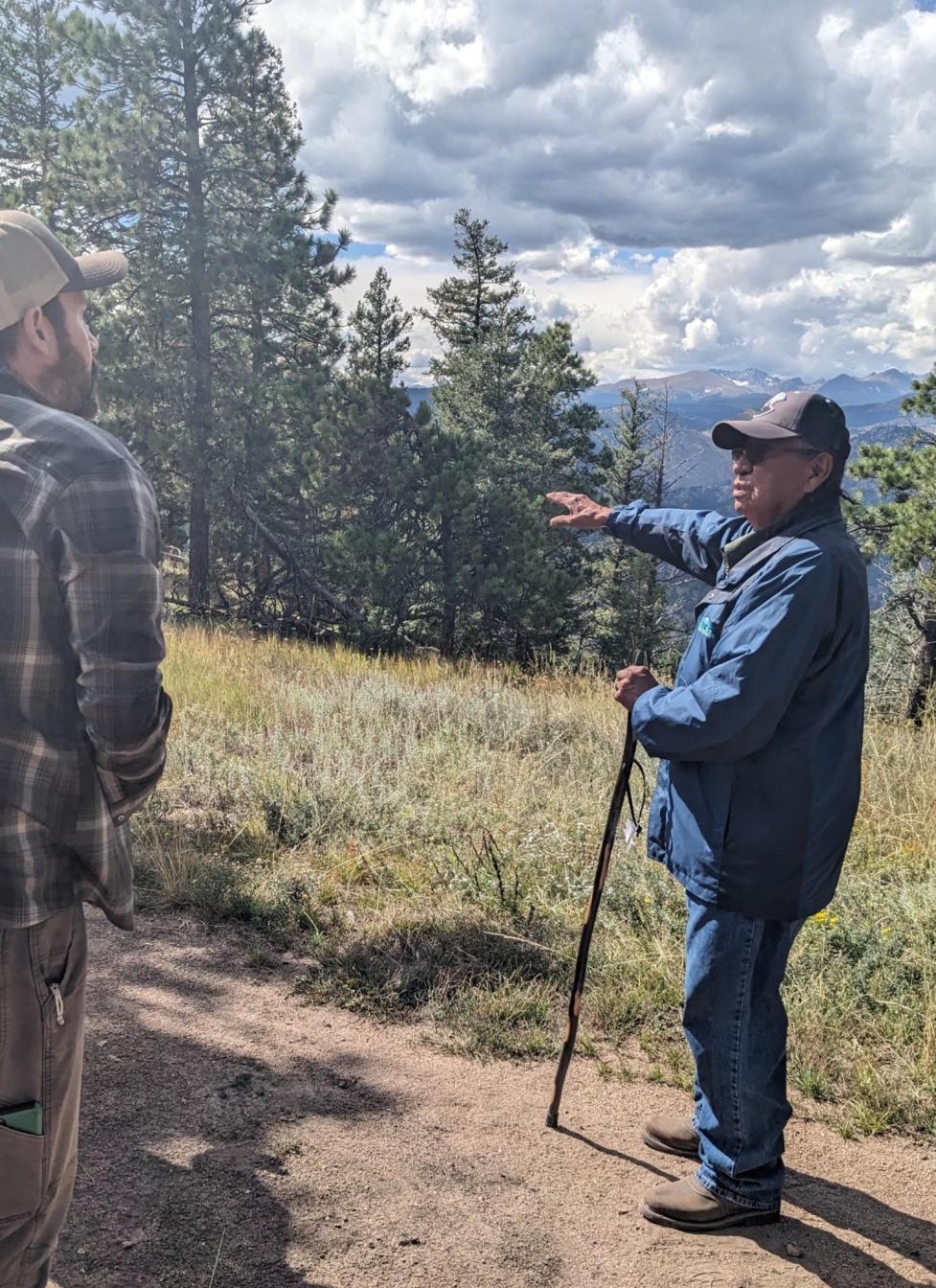
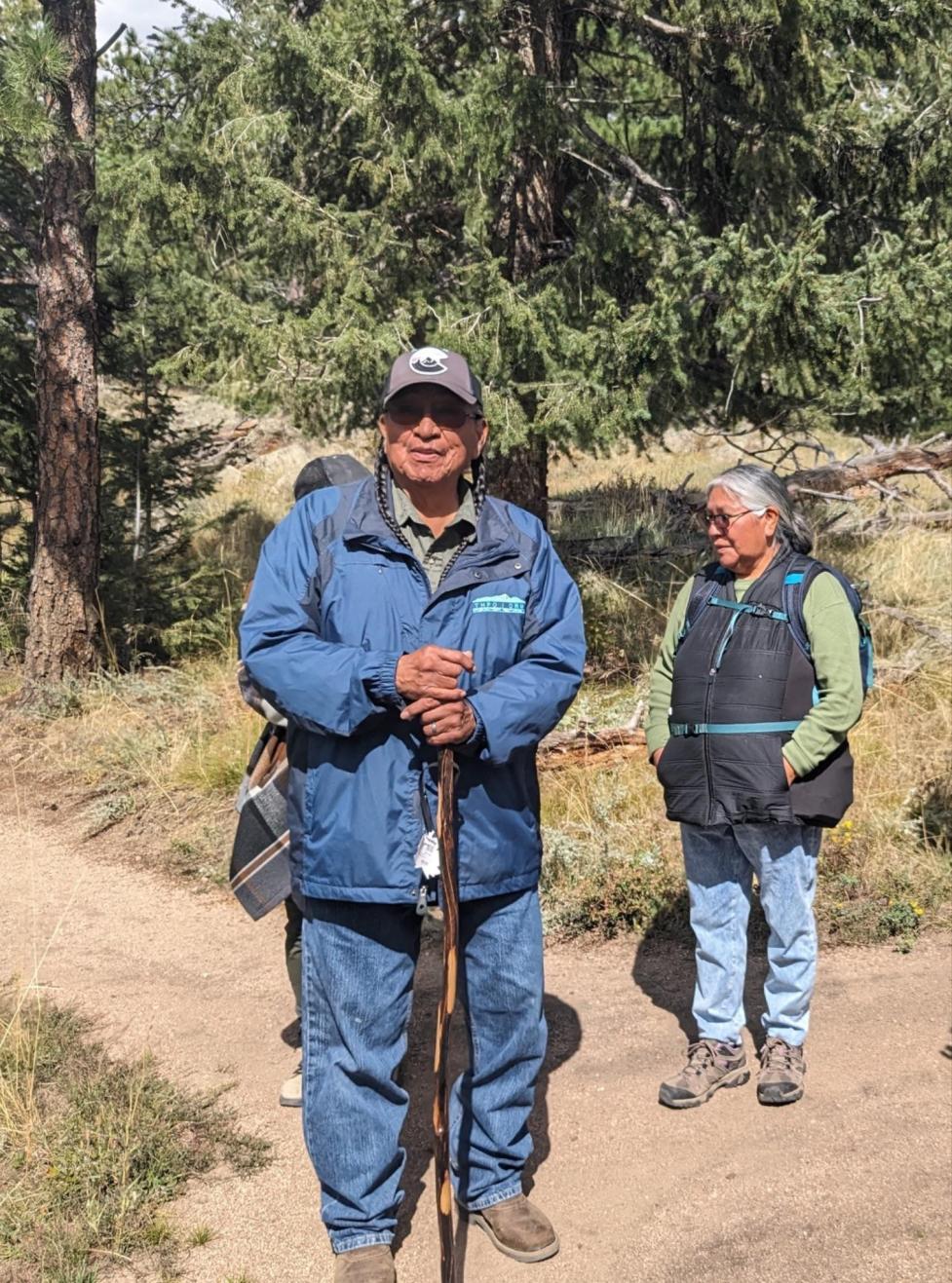
Mr. Terry Knight stands on a wooded trail in profile, speaking to someone off‑camera.

Mr. Knight discussing the landscape

Though Ute presence in the Boulder Valley was disrupted by settler colonialism, removal, and land dispossession, the area remains part of a broader homeland that includes present-day Colorado and surrounding states. Historians like Robert Emmitt (1954) and Virginia McConnell Simmons (2000) document the extensive use of the Front Range by Ute bands before forced removals.

“When they migrated along the front range, so basically the Mouache band and Capote and the Grand River Utes, some of them had all intermingled. My great grandfather and him and his, used to come across over to hunt buffalo or whatever; they would go up to Laramie to hunt. They didn't stay along the river, they moved around like anybody else did. And they’d get into skirmishes with the Arapahoe and sometimes the Cheyenne and when the Lakotas would come across... and they would get in to with them because they were coming onto Ute hunting grounds. But they didn't say “that's my land”, they’d say “that's my hunting area”. That's what all the other Tribes are looking for: hunting grounds, and that's what they were fighting. Not because of the land, because of the ground, hunting grounds that they were encroaching on.”

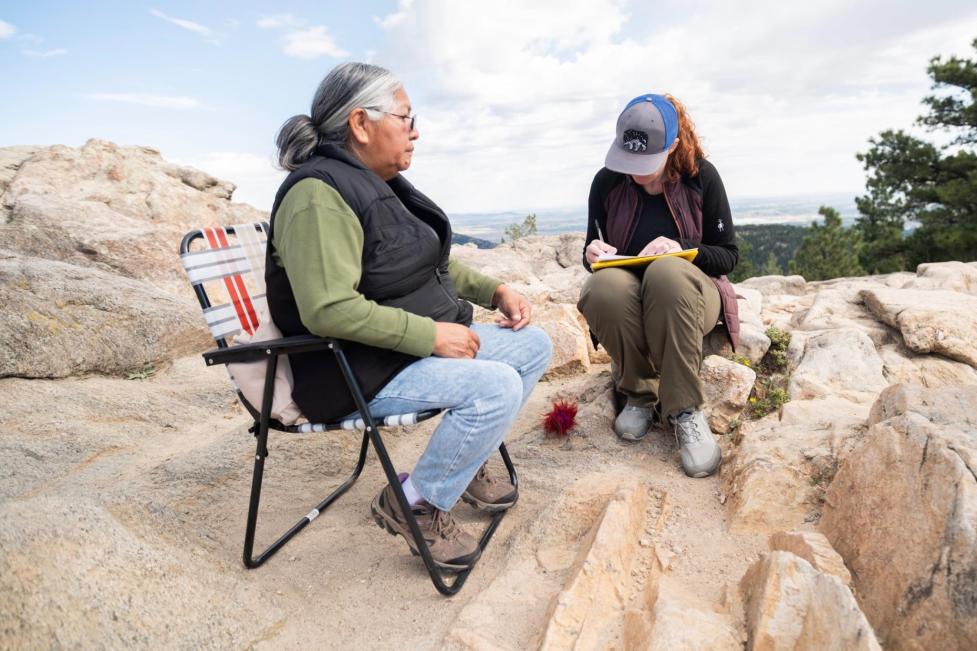
Ms. Cindy Badback and Jessica Yaquinto sit in a rocky area; Ms. Badback speaks while Jessica looks down at her notes.

A Tribal Elder talking with Jessica Yaquinto, LHA ethnographer

Despite historical rupture, contemporary Ute voices assert an ongoing connection to Boulder through memory, cultural practice, and educational outreach. As a Ute Mountain Ute Tribe Tribal Elder remarked, “we’re not here for the money, we’re here for the land… that’s our riches”—a sentiment echoed by David Rich Lewis (1994), who notes that Indigenous worldviews frame land not as property but as kin, a source of life and identity.

"We were here when they discovered all this gold... that’s when they pushed us out... they made treaties to make what they did was right... they stole all that….the chiefs... could not read English... I think that’s against some law, isn’t it?... These people did not understand English... so how can you say that’s a legal document?"
-Mr. Terry Knight

Recounting how he grew up living with his grandparents in a stone structure. Mr. Knight shared “We used what was available. To have shelter, to have food, whatever. If it's from the animals or if it's from berries, fruit or roots in the ground, we know where to get them and then she [my grandmother] knew how to process it. But my grandmother had been in this front range a long time. And then the pictures down at the Garden of the Gods? She's in a lot of those pictures, her and her mom, and my mother when she was 4 years old.”

The Ute people have experienced profound cultural and physical displacement through settler colonialism, which not only removed them from ancestral lands but also systematically erased their histories from public memory. A pariticpating Tribal Elder expresses frustration that significant events like the ‘Posey War’ remain largely untaught, reflecting a broader absence of Native perspectives in education and public narratives—a silence that reinforces cultural marginalization. As Virginia McConnell Simmons (2000) and Robert Emmitt (1954) describe, the forced removal of Utes from Colorado and the renaming of sacred places severed vital connections to land, identity, and history. A Ute Mountain Ute Tribal Elder highlights how exclusion from traditional territories—due to development, allotments, or off-road vehicle damage—prevents cultural practices such as gathering tea or making offerings, further deepening the rupture. This disconnection is not merely material but spiritual, as land is understood not as property but as kin. Calls to restore Indigenous stewardship and visibility, including accurate signage and education, reflect ongoing efforts to reclaim historical truth and revitalize Ute cultural presence in their homelands (Denison 2017; Lewis 1994).

The History of how Non-Natives came to Boulder

As told by Mr. Terry Knight, as it was told to him by the late Mr. Neil Cloud, Southern Ute Indian Tribe Native American Graves Protection and Repatriation Act (NAGPRA) Coordinator. As was told to Mr. Neil Cloud by his grandfather, who was present for the events described.

Neil Cloud’s grandfather [a Ute leader] gave his permission for these poor, ragged people that were coming from the east, they came here, and the Chief at that time, he went to talk to them, and he saw them, and they were just poor, poor people.

And whoever it was that they were following (their leader) said, “we come across the plains and we're here, we're tired, we're hungry, we got no food, we got, we got nothing.” and Chief said, “yeah, I see that.”

They said “we're gonna camp here for a while”

“well go ahead. You know, there's food here, there's game, there's fish and there's water. Go ahead, stay here as long as you have to. And I'm giving you permission to stay here.” And they said “thank you”.

And so (Chief) went back to the people and told them. “These people are poor, you know, they need to find some place to stay for a while and until they get all right.”

Then (the Chief) saw the Ute people, and told the Ute people, “What do you think?” They said, “Yeah, I guess so.”

And one woman said, “Yeah, poor people, you know, what harm can they do?” And they left went back over the mountain. And I don't know how long it took for them [the Ute] to make that migration route and come back around. By the time they came back here, those people were still here!

So, when Chief remembered that were Ute people said “Ah, let them stay here. What, what harm can they do? They need a place to live, and we got all this mountain here, we got all this land and everything, and the Utes we’re just a handful. And these people needed a place to live.” The Utes told them to “Go ahead, you know, you can stay here, no problemo”. So, I must say, “Oh, I see you're still here.”

Reciprocity and Respect

The Ute worldview sees nature not as a resource to be owned or exploited but as a living relative deserving of respect, listening, and offerings. As A Ute Mountain Ute Tribal Elder put it, “we don’t say that these mountains were ours... nothing is ours... we just use what there is,” reflecting a philosophy of shared use and humility. Denison (2017) frames this perspective as a land religion—one where prayer, offerings, and presence maintain balance and honor sacred geographies. Ritual acts, like setting aside food before meals or preserving sacred plants in the home, serve as spiritual maintenance, ensuring harmony and abundance for all beings.

“Before I eat, I put a little aside — that’s my offering.”
-Tribal Elder

The belief that land holds memory and energy—“the energy is still here in the mountains”— reflects what Robert McPherson (2011) documents among the White Mesa Utes: landscapes imbued with spirit and ancestral presence. Sites such as lookout points, springs, and ceremonial spaces are approached with offerings and care. These places are not only spiritually potent but ecologically significant, and their misuse or development disrupts both physical and cultural ecosystems. Lewis (1994) observes that Indigenous ideas about land favor kinship, care, and spiritual reciprocity. Even when displacement or land destruction occurs, Ute spiritual connection survives through memory, storytelling, and ceremony.

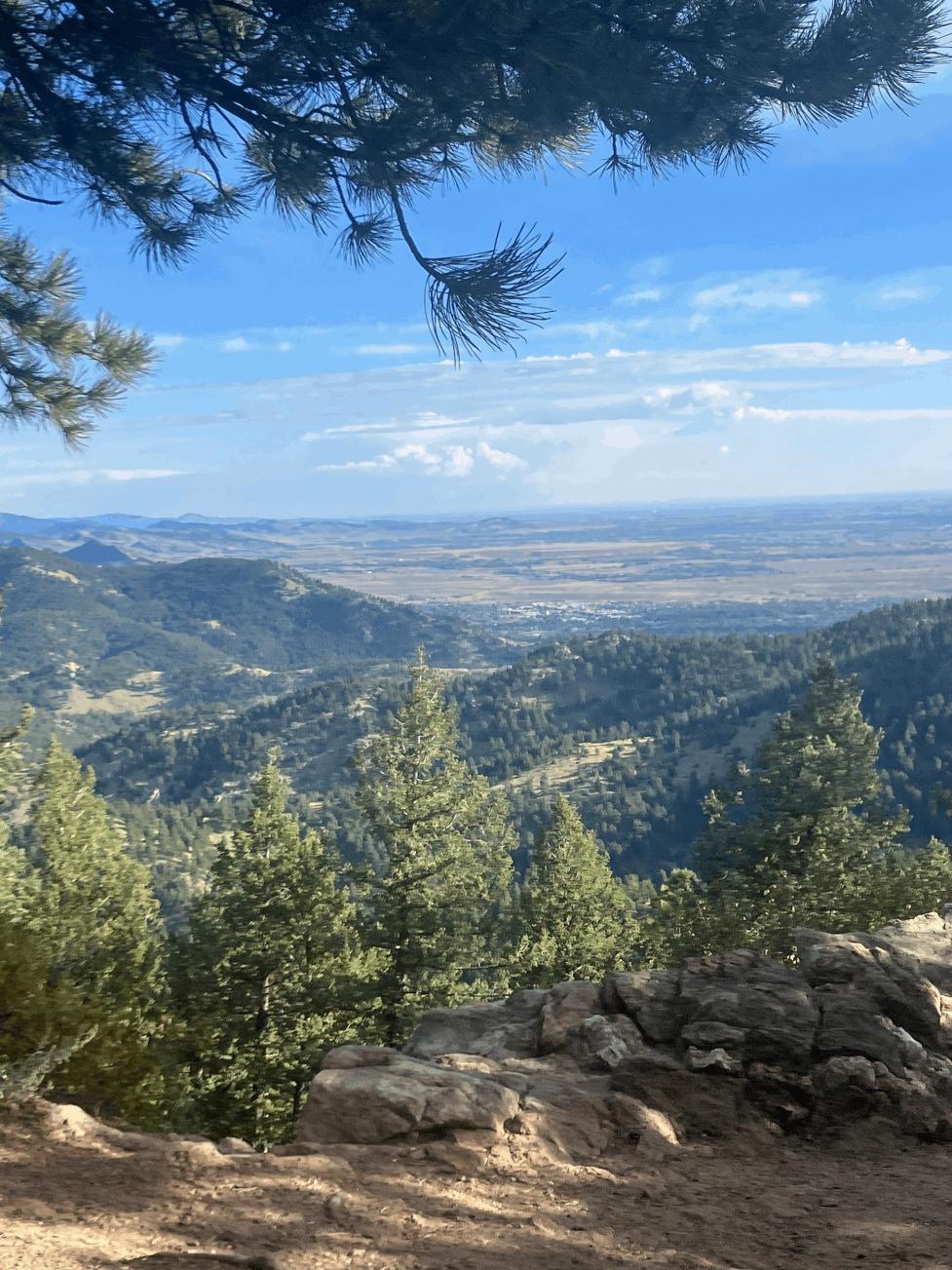
Landscape view from Boulder OSMP with tree branches and small conifers in the foreground, and green hills and mountains in the distance.

"...you do not make money off what was given to us by the creator... He gave us everything... if we sell it... he’s gonna gradually take that away..."
-Ute Mountain Ute Tribal Elder

Traditional Use and Ecological Knowledge

Ute land use was historically defined by mobility, seasonal migration, and deep familiarity with local ecosystems. Rather than build permanent settlements, Ute families moved through high country, valleys, and plains, setting up small camps near water and food sources. As Terry Knight explains, a 16-foot teepee was often sufficient, especially in places selected for access to resources or spiritual significance. Lookout points, such as those used to monitor game or approaching camps, held both practical and ceremonial value. The late Mr. Clifford Duncan (2003) and Mr. Fred Conetah (1982), of the Ute Indian Tribe of the Uintah and Ouray Reservation, emphasized the sophistication of this mobility, guided by tradition and an intimate knowledge of terrain. Mr. Knight explained that campsites had to be in level areas within walking distance to water, but not too close to the water. High areas were used at lookouts to ‘see who's coming’.

Mountains themselves hold deep cultural, spiritual, and practical importance to the Ute people. They are seen not only as homelands but also as sacred places where stories, traditions, and ceremonies are rooted. Many Ute oral histories describe the mountains as living beings with power and A Tribal Elder explained that they are cleansing places with energy you can feel through your bare feet. Mountains also provide essential resources such as water, plants, and game, which sustained Ute communities for generations. Beyond their material importance, mountains embody the Ute worldview of balance and interrelatedness with nature, reminding the people of their responsibility to respect, care for, and maintain harmony with the land. For the Utes, mountains are more than landscapes; they are relatives, teachers, and sources of identity.

Traditional subsistence practices were taught from generation to generation. Mr. Knight and A Tribal Elder describe purifying spring water, eating rabbits and berries, and using wild plants for flavor or nutrition. These practices align with Fowler and Fowler’s (1971) research on Numicspeaking peoples, who lived sustainably off the land through observation and adaptation. Cooperation was key: youth helped elders meals were shared, and every outing was a lesson. As Lewis (1994) writes, “these habits were not just for survival but formed the basis of a land-based cultural ethic, in which people moved not aimlessly, but with purpose, tradition, and respect.”

“They don't say ‘I'm teaching you.’ I guess they expect you to observe and learn.”
-Mr. Terry Knight

Seasonal Gathering and Foodways

In the Boulder Valley, Ute families gathered a variety of native plants, including pinyon nuts, chokecherries, wild onions, strawberries, yucca, and prickly pear. These seasonal camps were intergenerational, with adults teaching children how to harvest, prepare, and respect the plants. Yucca was roasted over fire like squash or processed into natural soap. The stalks were sometimes used for weaving, especially sandals. Prickly pear and barrel cactus fruit, once scorched to remove spines, was described as tasting like apricots. Wild rose hips and strawberries added sweetness, though Mr. Knight humorously recalled breaking out in a rash after eating wild strawberries that hadn’t been properly cleaned.

“We’ve forgotten to give thanks to what we plant. This year, I didn’t offer anything — my corn came out too early, too small. It didn’t grow right.”
-Mr. Terry Knight

Mr. Terry Knight smiles at the camera on a wooded trail, while Ms. Cindy Badback appears in profile speaking to someone off‑camera.

On an OSMP trail

These traditional foodways reflect more than subsistence—they represent cultural continuity, environmental stewardship, and ecological intelligence. Both Mr. Knight and A Tribal Elder expressed concern about modern disruptions, such as off-road vehicles damaging gathering sites or land use policies that restrict access. Denison (2017) and Jones (2019) both highlight how such interruptions erode not just food sources, but the cultural and spiritual relationships tied to place. In this context, the Boulder Valley is a living archive of Ute heritage, where each plant, trail, and lookout holds layered meaning—nourishing body, memory, and spirit.

"...just to give thanks to the creator for all this... ceremonies... sacred site... offering... whenever they go somewhere... they always give offering... they understood who Creator was..."
-Mr. Terry Knight

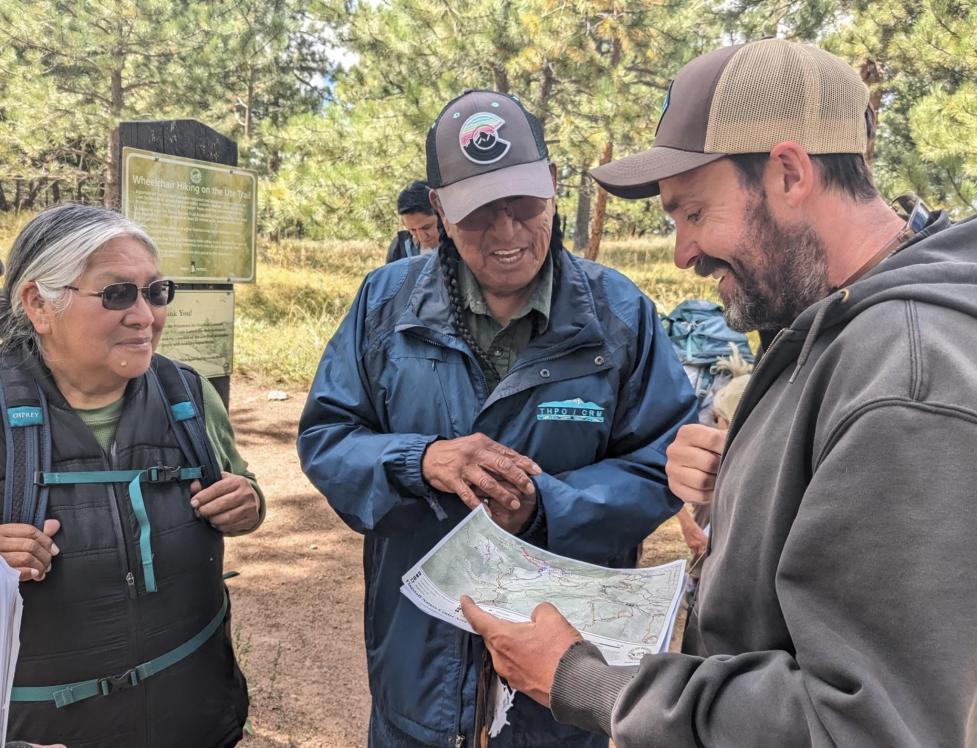
Three people stand in a semicircle near a trailhead sign, laughing as they look over a map.

Reviewing maps with Boulder OSMP staff

Final Thoughts

Ute Mountain Ute Representatives advocated for keeping open spaces “natural” rather than developing them “till it looks like Main Street in Boulder,” emphasizing that true connection to the land requires preservation and spiritual attentiveness. Nature, they argue, is not simply a recreational backdrop for weekend visitors, but a living teacher, holding ancestral memory and offering space for reflection, prayer, and healing. As a Tribal Elder reflected, “being out here helps me reflect on what my aunts and uncles taught me” a reminder that cultural transmission and healing can only continue if the land remains respected and intact.

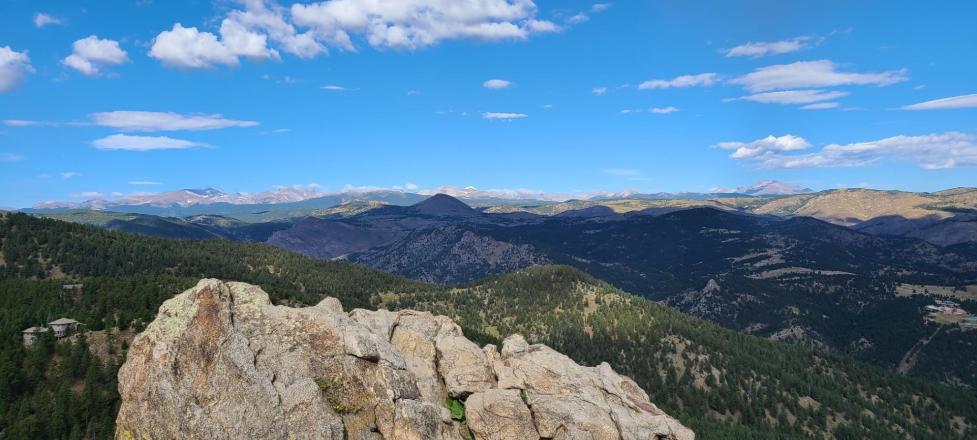
View from a Boulder OSMP trail with large rocks in the foreground, green conifer‑covered mountains in the midground, and snow‑topped peaks in the distance.

Bibliography

Conetah, Fred A. A History of the Northern Ute People. Edited by Kathryn L. MacKay and Floyd A. O’Neil. Fort Duchesne, UT: Uintah and Ouray Ute Tribe, 1982.

Denison, Brandi. Ute Land Religion in the American West, 1879–2009. Lincoln: University of Nebraska Press and the American Philosophical Society, 2017. Duncan, Clifford. “The Northern Utes of Utah.” In A History of Utah’s American Indians, edited by Forrest S. Cuch, 1–50. Salt Lake City: Utah Division of Indian Affairs and Utah Division of State History, 2003.

Emmitt, Robert. The Last War Trail: The Utes and the Settlement of Colorado. Norman: University of Oklahoma Press, 1954.

Fowler, Don D., and Catherine S. Fowler, eds. Anthropology of the Numa: John Wesley Powell's Manuscripts on the Numic Peoples of Western North America, 1868–1880. Washington, D.C.: Smithsonian Institution Press, 1971.

Jones, Sondra G. Being and Becoming Ute: The Story of an American Indian People. Salt Lake City: The University of Utah Press, 2019.

Lewis, David Rich. Neither Wolf Nor Dog: American Indians, Environment, and Agrarian Change. New York: Oxford University Press, 1994.

McPherson, Robert S. Comb Ridge and Its People: The Ethnohistory of a Rock. Logan: Utah State University Press, 2009.

As If the Land Owned Us: An Ethnohistory of the White Mesa Utes. Salt Lake City: University of Utah Press, 2011.

O’Meara, Sean for Anthropological Research Group, LLC. Indigenous Connections: Native American Ethnographic Study of Golden, Colorado and the Clear Creek Valley. Golden, Colorado: The City of Golden, Colorado. 2022, Revised 2025.

O’Neil, Floyd A. The Southern Utes: A Tribal History. Ignacio, CO: University of Utah Printing Service, 1972.

Petit, Jan. Utes: The Mountain People. Revised edition. Boulder: Johnson Books, 1990. Silbernagel, Robert. Troubled Trails: The Meeker Affair and the Expulsion of the Utes from Colorado. Salt Lake City: The University of Utah Press, 2011.

Simmons, Beth. “Introducing Colorow, a Jefferson County Legend.” Historically Jeffco, no. 36 (2015): 22–27.

Simmons, Virginia McConnell. The Ute Indians of Utah, Colorado, and New Mexico. Boulder: University Press of Colorado, 2000.

Young, Richard K. The Ute Indians of Colorado in the Twentieth Century. Norman: University of Oklahoma Press, 1997.

Ethnographic Education Report Navigation

Explore the other reports linked below.

Lakota

The City of Boulder Ethnographic Education Report: Lakota: The Oglala Sioux Tribe and The Rosebud Sioux Tribe

Pawnee Nation

The City of Boulder Ethnographic Education Report: Pawnee Nation

Ethnographic Education Report Introduction