Preble’s Meadow Jumping Mouse
Critical habitat for the Preble’s Meadow Jumping Mouse occurs on the eastern part of the property east of 55th Street. The land west of 55th Street does not provide critical habitat for the mouse or any other sensitive species. The critical mouse habitat is not affected by the project. The critical habitat is shown in Figure 4 of the 2025 Ecological Report.
Prairie Dogs
The 2025 Ecological Report, prepared by a professional consultant, indicated there were no prairie dogs on the site. A small area of abandoned prairie dog burrows was present in the north-central part of the site. Prairie dogs were not observed at the site when it was examined for prairie dogs 8 different times over 6 months. The old burrows were collapsing and there were no signs of prairie dog scat or vegetation grazing.
Wetlands Mapping
Wetlands mapping accepted during the annexation was based on the 2024 wetlands mapping. Staff discovered a significant discrepancy between the 2016 and 2024 wetlands maps. Several breaches in the ditch bank along the south edge of the property were discovered and shored up to prevent unmonitored flood irrigation from the ditch across the property from south to north. Staff will resubmit wetlands mapping after groundwater monitoring is completed in the summer of 2026. More information about the wetlands can be found in the 2025 Ecological Report.
Noise and Light Impact
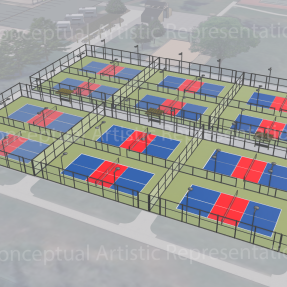
Court lights will include timers, activated by players for a specified length of time and not allowed to function after the designated play time. This is a best practice for the court lights across the BPR system. The tennis courts are located in the area closest to the existing parking lot and 55th Street. The courts will adhere to the city noise ordinance and have posted playing hours, in line with best practices for courts across the BPR system. Pickleball was intentionally placed adjacent to the handball courts to reduce noise impacts on neighbors and potential habitat.
Stormwater Filtration and Retention
The project is required by code to include appropriate stormwater filtration and retention. The department prioritizes preserving water quality and will address the known concerns about the high water table and its effects on neighboring properties.
Botanic Garden
Staff believe a botanic garden could be an appropriate use of areas of the parkland not set for court development. Staff have offered a path forward, including help coalescing thoughts and ideas into a proposal that can be effectively reviewed and considered by the department. A proposal has not been received. If a proposal is submitted, it will be reviewed, considered and routed through proper channels.
Tribal Consultation
City staff recognize the importance of honoring Tribal sovereignty and self-determination and conducts government-to-government consultations with Tribal Representatives appointed by federally recognized Tribal Nations. One result of this consultation is the Fort Chambers/Poor Farm Management Plan.
Last year, the City of Boulder worked on a project with Arapaho and Cheyenne Tribal Representatives to complete a long-term planning process to create a concept plan for land with a direct community connection to the Sand Creek Massacre.
In addition, the City of Boulder and Representatives from the Arapaho and Cheyenne Tribal Nations worked with the city to complete a collaborative stewardship plan based on the vision "Heal the land; Heal the people." The plan guides how the city cares for the Fort Chambers / Poor Farm site, preserving agriculture, supporting future visitor use and enhancing natural ecosystems. Learn about the site's historical, ecological and agricultural features and its direct connection to the Sand Creek Massacre.
Staff are seeking guidance on the East Boulder Community Park property with our official Tribal partners. The outcomes of the collaboration will be shared as soon as available.
Purchase of Property
Community members have expressed their desire to purchase the Hogan Pancost Property. The property is not currently for sale and is designated to meet community stormwater detention and parkland needs. No offer has been made outside of emails stating the intent. The sale of any park property would require a public process outlined in the Boulder Municipal Code. Sec. 162. - Disposal of park properties:
Park lands may be disposed of by the city council, but only upon the affirmative vote of at least four members of the parks and recreation advisory board. An advisory recommendation, which shall not be binding on the council, shall be obtained from the planning board prior to the disposition or lease of park lands. (Added by Ord. No. 2392 (1961), § 1, adopted by electorate on January 31, 1961. Amended by Ord. No. 5574 (1993), § 1, adopted by electorate on November 2, 1993.)