

Use the blue card menu below to jump into a topic.
Boulder Is Consistently Rated as One of the Best Places to Bike in the Country
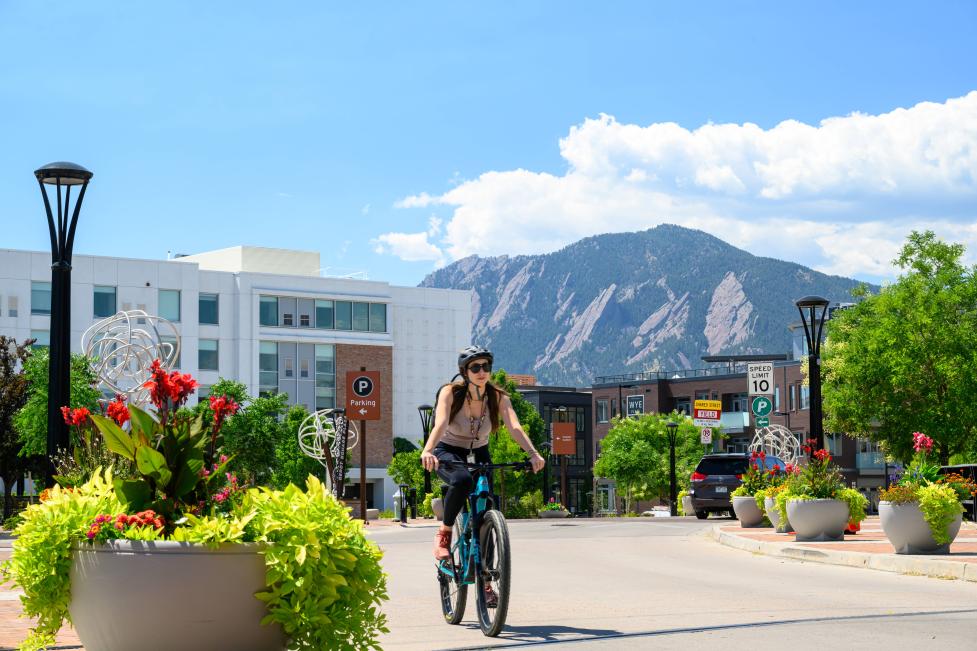
With an active culture, more than 300 days of sunshine and hundreds of miles of bikeways, Boulder is a great place for bicycling.
A well-connected network of multi-use paths separated from vehicle traffic makes it possible for almost completely uninterrupted bike travel, no matter where you’re headed.
Guide Navigation

Plan your route
Find local and regional bike maps for commuting and recreation
Which wheels go where?
Learn where different devices can ride in Boulder
Riding safely
Find rules and riding etiquette
Bike security
Find resources for bike parking, registration and theft prevention
Make a report
Report a crash, close call, or stolen bike
Add bike parking
Learn how to add short-term bike parking to your business
Our vision
Explore our community-informed vision
City Council Priority: Bike Security
Plan Your Route
City Trails Map
Recreational Bike Routes
Circle Boulder by bike with the B360 or B180 routes! B360 is a 24-mile loop that circles the entire city. B180 is a 12-mile route. Both are great ways to explore town and all that biking in Boulder has to offer.
Which Wheels Go Where
You are responsible for knowing where your device is allowed.
| VEHICLE TYPE/CLASS | SIDEWALKS* (EXCEPT DISMOUNT ZONES) | MULTI-USE PATHS | STREETS & BIKE LANES | Trails |
|---|---|---|---|---|

(max speed of 20 mph) | ✔️ | ✔️ | ✔️ | Only on some trails. |
|
(max speed of 28 mph) | ❌ | ❌ | ✔️ | ❌ |

| ❌ | ❌ | Streets: ✔️ Bike Lanes: ❌ | ❌ |

Lightweight Electric Vehicle | * ❌ | ✔️ | ✔️ | ❌ |

| These devices are not allowed in the city. | |||
-
What about "e-motos"?
E-motos are not allowed on Boulder's transportation system. While the term "e-motos" is not currently defined in Boulder Revised Code, you can think of them as Toy Vehicles depending on the size of motor, watt output and other specifications. View definitions.
Remember: two wheels and electric power don’t equal an e-bike.
Feature Class 1, 2 or 3
Electric BicycleE-Moto Operable Pedals Required Not required (often unoperable) Motor Power ≤ 750W > 750W (some models up to 6,000W) Top Speed ≤ 20-28 mph 30-65+ mph Throttle Class 2 only (≤ 20 mph) Usually throttle only Licensing/Registration No Required Product Category Consumer Product Motor Vehicle (requires license, registration, insurance) Street Legal for Minors All ages can operate a Class 1 and 2 e-bike.
Ages 16+ can operate a Class 3 e-bike only on streets and bike lanes.
Ages 16-17 must wear a helmet as the passenger or driver.No, unless the device is registered, licensed, and insured, and the rider meets minimum age requirements.
Ride Safely & Courteously
Safety starts with you.
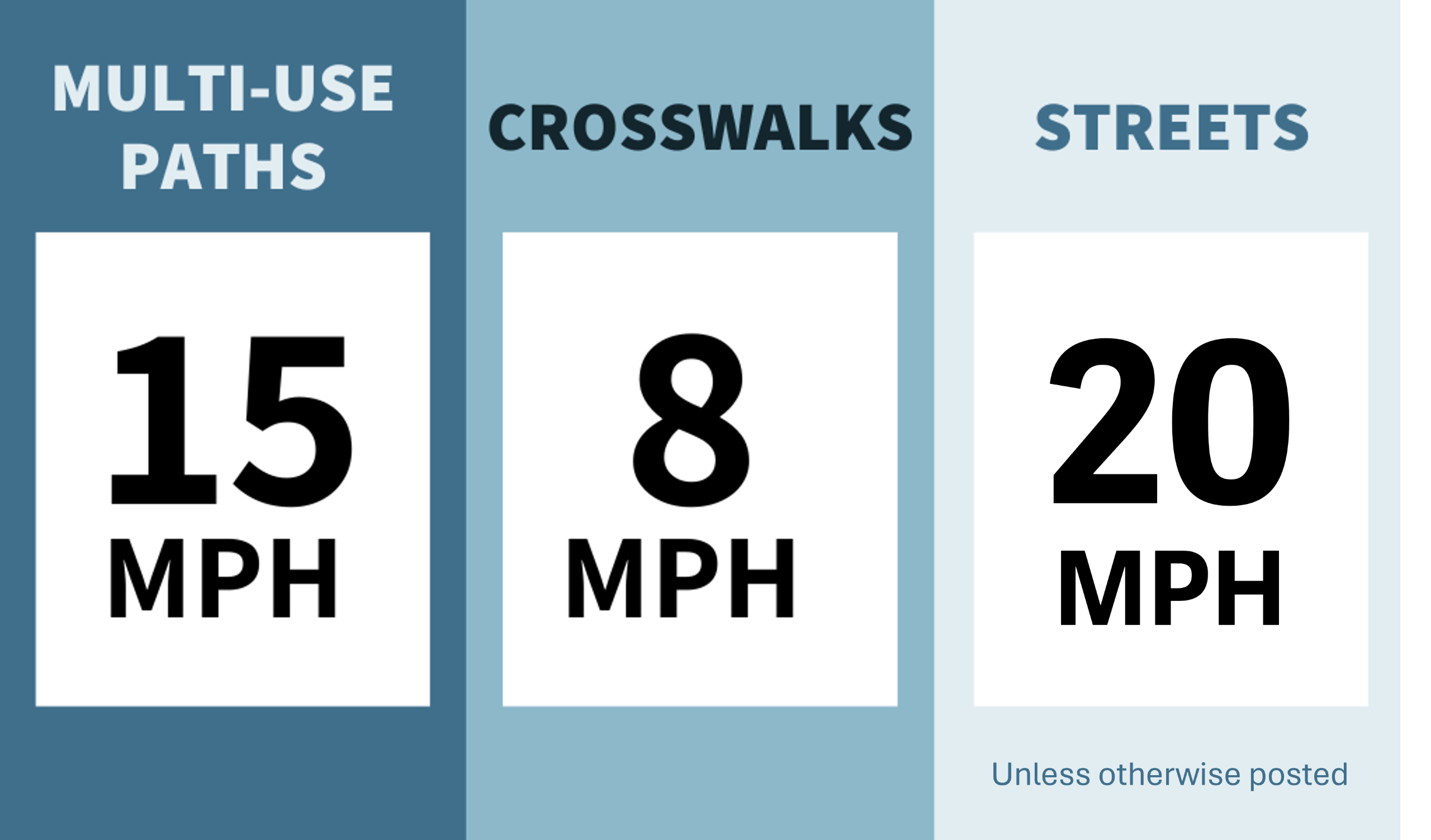
- Keep right, pass left, and give an audible alert before passing. Always ride with the flow of traffic.
- Bicyclists must yield to pedestrians.
- The 'Safety Stop' in state law allows riders of low-speed devices, such as bikes and scooters, the option to ride slowly through stop signs without stopping first as long as they yield to pedestrians and other road users who have the right-of-way.
- Bikes are required to have a white light on the front and a red light on the back when riding after dusk or before dawn.
-
Dismount Zones
Riding bikes and other wheeled devices on the sidewalk, except for accessibility purposes, is prohibited downtown on and around the Pearl Street Mall and in the University Hill commercial area. You must dismount these wheeled devices in Dismount Zones.
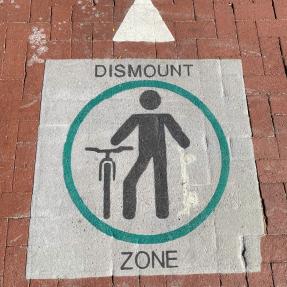
A dismount zone symbol on the ground. Outside of dismount zones, bikes can be ridden in all bike lanes and on all streets, multi-use paths and sidewalks.
Tips for Trails
- Yield to all other trail users and bicyclists traveling uphill.
- Control your speed at all times. Safe speeds vary with trail conditions and traffic.
- Practice minimum-impact bicycling: avoid muddy trails, skidding, hard braking and shortcutting. Riding on wet or muddy trails causes serious trail erosion and may result in a temporary trail closure.
Boulder is better when we move together.
- Be aware. When driving, look for people walking, biking and rolling.
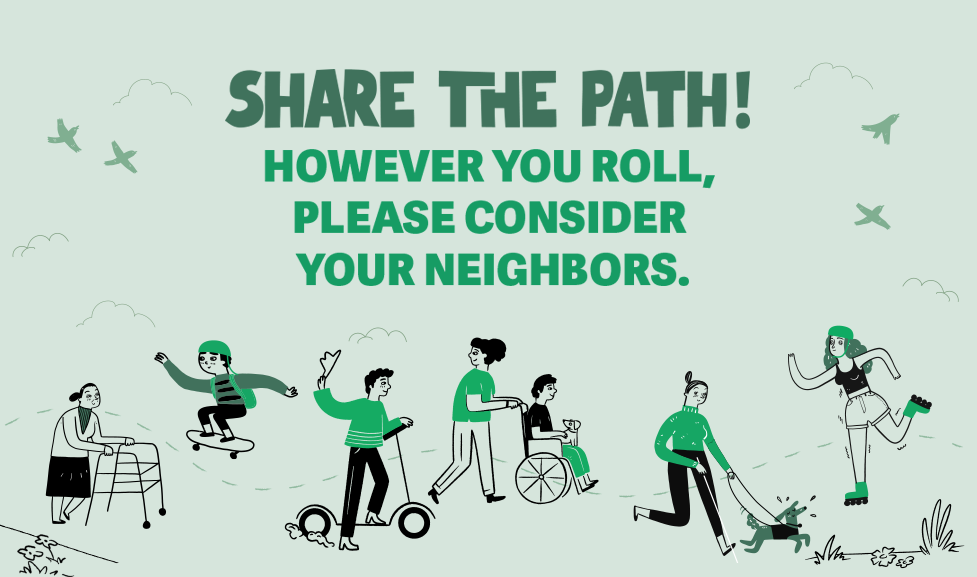
- Be mindful. Move with care and make space for others on shared paths.
- Be predictable. When turning or crossing, smile, signal or wave.
- Walk right and pass left. Slow down, yield and give space when passing.
- Signal audibly to let others know you're passing.
- Be here now: enjoy the journey. Take in Boulder views and take the time to enjoy the social connection that slower travel offers.
Rules for Electric Devices
Different rules may apply to different types of devices, like e-bikes. Learn more below or on the e-micromobility webpage.
The City of Boulder provides shared e-scooters and e-bikes through the Shared Micromobility Program, in partnership with the University of Colorado Boulder, Boulder County, the Boulder Chamber, Lime and BCycle. Learn how to use a BCycle e-bike and a Lime e-scooter.
City of Boulder Open Space and Mountain Parks (OSMP) allows Class 1 and 2 e-bikes on certain trails. On OSMP trails, people experiencing disabilities may use Other Power/Driven Mobility Devices (OPDMDs), including electric-assisted cycles and handcycles.
Boulder County allows e-bikes on most county-managed trails on the plains where regular bikes are permitted.
Bike Security
Register your bike
Registering your bike allows law enforcement to more easily contact you if your bicycle is found.
-
Fill out a simple form to register your bike with Boulder Police Department, this also registers it with BikeIndex.org.
-
You can also register your bike with CU Boulder – you don’t have to be a student.
-
Mark your bike
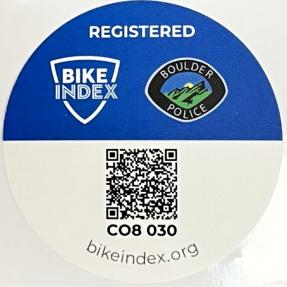
Once you register, you can get a sticker to deter thieves from the Boulder Police Department Community Engagement Unit (303-441-3322) or any city bike shop. Each sticker will have its own distinctive QR and code.
Parking your bike
Park your bicycle in a designated bike rack whenever possible and avoid parking your bike on trees, signs and other structures. Park in a well-lit, visible, populated area.
- Free bicycle racks are provided across Boulder to make it easier and more secure to park your bike.
- All official Open Space and Mountain Parks Trailheads also have bicycle racks.
Lock your bike
-
Buy a good lock!
When shopping for a bike lock, look for a U-lock or heavy-duty chain that is angle-grinder resistant and diamond rated.
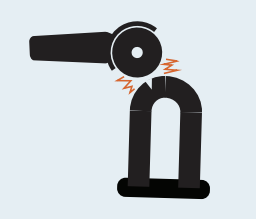
A high-quality lock can be expensive, but so is replacing a stolen bike! Purchase the best lock that you can afford.
-
Lock it up!
Always lock your bike when you leave it unattended, even when it is on your car’s bike rack, or in garages and yards.
Choose a sturdy structure, ideally an inverted “U” bike rack, to lock your bike to in a well-lit and busy area. Make sure the bike rack is firmly secured in the ground.
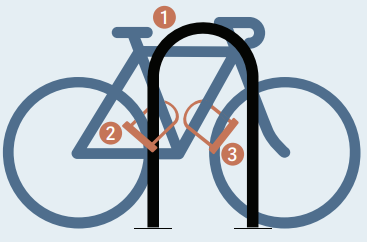
- Park your bike parallel to the bike rack to provide a steady spot to lock your bike and to allow another bike to park on the opposite side.
- Use a high-quality U-lock or heavy-duty chain to lock your frame and at least one wheel to the rack or structure.
- Use a second U-lock, ideally, or a chain or cable, to secure the other wheel to the frame.
Avoid leaving your bike outside overnight. If you must, consider using multiple locks to secure both wheels and the frame. Secure or take with you any easily removed parts and accessories, such as the seatpost, saddle, lights, pump and bags.
-
Make a report: stolen bike, crash or close call
Report a Close Call
- Submit a close call form on Inquire Boulder.
- You can also use the Inquire Boulder mobile app, available on the App Store and Google Play.
- Reporting close calls helps the city identify potential trouble spots in our transportation network.
Report a Stolen Bike
- Complete the Boulder Police Department Online Report to record your name and contact information, along with the bicycle make, model and serial number. Law enforcement will use this database to contact you if they recover your bicycle.
- If you have an account with Bike Index, update your bicycle's status to stolen.
Boulder Stolen Bikes Dashboard
Our Vision
Boulder has more than 300 miles of bikeway, including 96 miles of bike lanes, more than 80 bike and pedestrian underpasses, 84 miles of multi-use paths, 50 miles of designated bike routes and Neighborhood GreenStreets prioritized for bicycle and pedestrian travel.
Improving bicycle safety and comfort and building our bicycle network are key goals of our community-informed vision:
We're also working together with our partners to continue strengthening regional bike connections.