

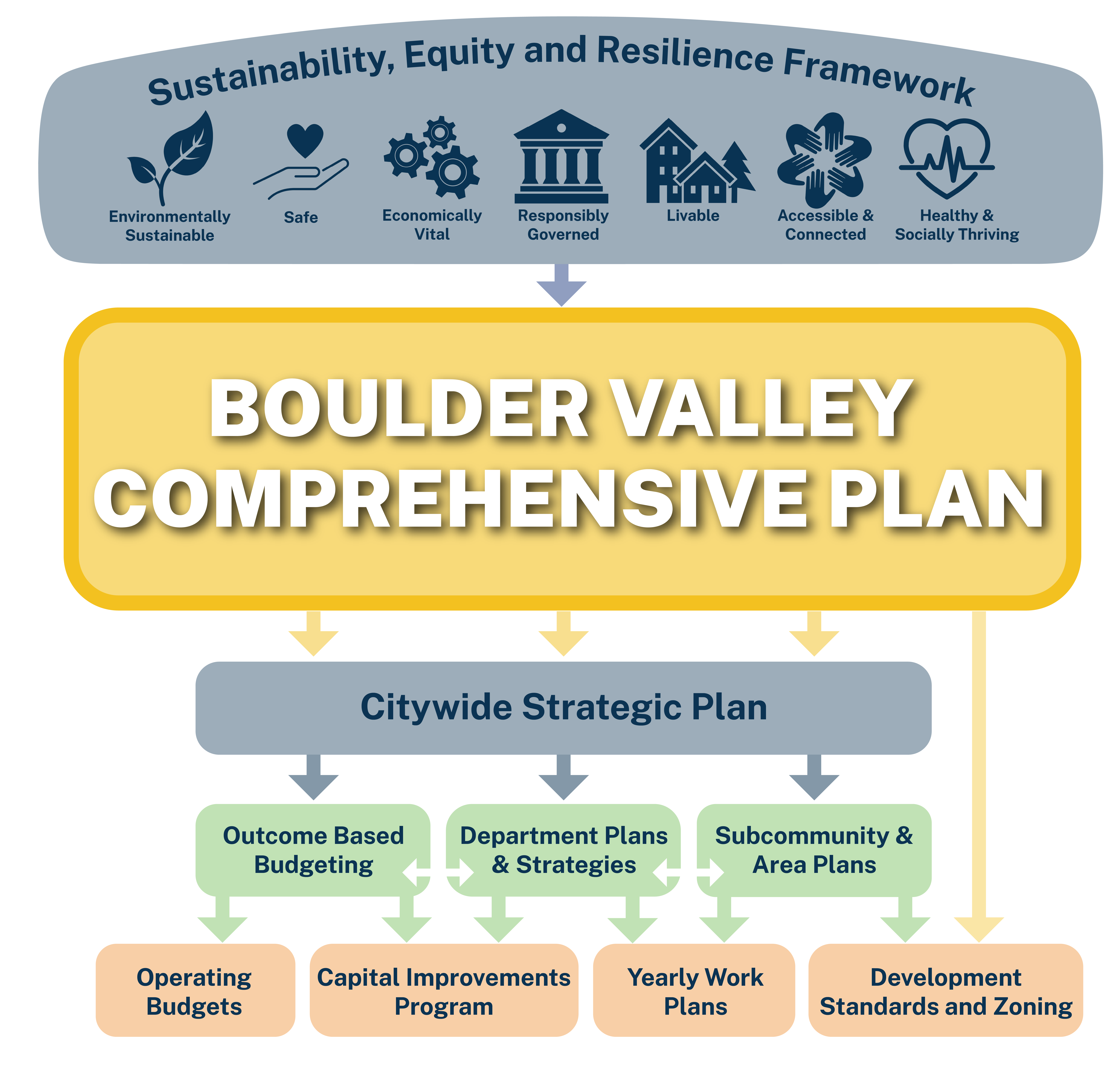
Diagram that describes the hierarchy of city planning and implementation efforts. The overarching framework is the Sustainability, Equity and Resilience Framework which includes seven goals: Environmentally Sustainable, Safe, Economically Vital, Responsibly Governed, Livable, Accessible and Connected, and Healthy and Socially Thriving. Under this is the Boulder Valley Comprehensive Plan. The next level includes the Citywide Strategic Plan, then Outcome Based Budgeting, Department Plans and Strategies, Subcommunity and Area Plans. And finally, implementation happens through operating budgets, the Capital Improvements Program, yearly work plans and development standards and zoning.
Sustainability, Equity and Resilience Framework
The city’s Sustainability, Equity and Resilience (SER) Framework reflects core community values: caring for people, protecting the natural environment and planning for a strong and adaptable future. All other city plans, projects and decisions are rooted in this framework.
Citywide Strategic Plan
The Citywide Strategic Plan is step forward towards action. This four-year plan identifies major strategies and is used alongside City Council priorities to coordinate work across city departments.
Budget
The city uses an outcome-based budgeting approach, also known as Budgeting for Resilience and Equity. This approach enables the city to use data-driven decision-making to understand the impact of funding choices and the allocation of resources in support of the Boulder Valley Comprehensive Plan.
Department Plans
City department plans interpret the vision and policies provided in the comprehensive plan for specific departments. “Blueprint” plans similarly provide interpretation of the comprehensive plan, but for broad focus areas that cross over departments. They provide detailed policies, priorities, service standards, asset and system needs and capital plans to create a roadmap for budget and workplan priorities within each city department.
Subcommunity and Area Plans
Subcommunity and Area Plans provide direction for specific geographic areas. They help implement the comprehensive plan and offer more specific guidance for anticipated land uses, design character, mobility facilities and programming. Through the subcommunity and area planning process, the city identifies underutilized land for new development with potential to address community needs. These plans assess the location of sites relative to transit and jobs, infrastructure needs, availability of public facilities and services and transportation capacity.
Capital Improvement Program
Capital improvements carry out comprehensive plan policies through the provision and maintenance of urban services, facilities and public infrastructure. The city funds the construction and maintenance of assets using a wide range of sources. Funding and priorities for construction of capital improvements is planned on a six-year timeframe through the Capital Improvements Program.
Department Annual Work Plans
City departments prepare a work plan each year that is incorporated into the citywide annual work plan. Work plans include on-going business activities, projects and programs that are informed by and support the policies of the Boulder Valley Comprehensive Plan.
Development Standards and Zoning
The city zoning map assigns a zoning district to every parcel of land in the city. The Boulder Revised Code (B.R.C., 1981) defines the zoning districts and regulates allowable uses, the intensity of development and the form of structures on a site within the city. The county’s zoning code and map regulate properties within the Boulder Valley located in unincorporated Boulder County. The comprehensive plan and Future Land Use Map inform decisions about zoning in the Boulder Valley.